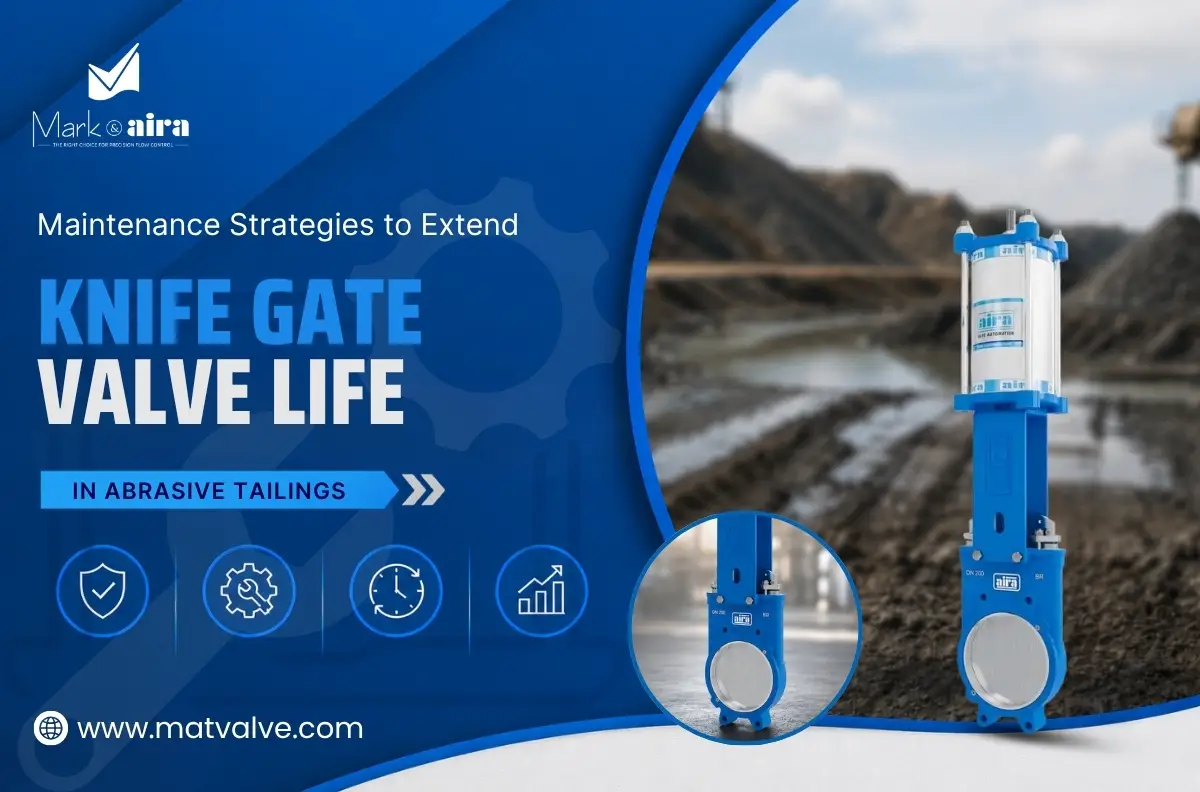
Mining and mineral processing operations handle some of the most aggressive process media found in industrial environments. Every day, thousands of tonnes of abrasive slurry move through pipelines carrying tailings, mineral concentrates, and waste materials from one stage of the process to another.
Unlike clean liquids, tailings contain high concentrations of solid particles that continuously impact internal pipeline components. Over time, this constant abrasion accelerates wear on pumps, pipelines, fittings, and especially isolation valves. If not managed effectively, excessive valve wear can lead to leakage, unplanned shutdowns, increased maintenance costs, and reduced production efficiency.
Among the various valve types used in slurry handling systems, knife gate valves are widely selected because of their ability to isolate media containing high solids content. However, even valves designed for abrasive service are not immune to wear. Their service life depends on several factors, including slurry characteristics, operating conditions, maintenance practices, and the suitability of the valve design for the application.
For mining operators, extending valve life is not simply about reducing replacement costs. It also improves equipment availability, minimises production interruptions, and contributes to safer maintenance operations.
This article examines the primary causes of mining knife gate valve wear, explains why abrasive tailings create severe operating conditions, and outlines practical engineering and maintenance strategies that help maximise valve service life in mining and mineral processing plants.
Quick Answer
How Can Mining Operations Extend the Wear Life of Knife Gate Valves?
The wear life of knife gate valves in mining applications can be significantly improved by selecting valves designed for abrasive slurry service, operating them within recommended conditions, and implementing a proactive maintenance programme. Factors such as slurry particle size, solids concentration, flow velocity, and valve cycling frequency all influence wear rates. Routine inspections, timely replacement of worn sealing components, operating torque monitoring, and selecting wear-resistant materials help reduce premature failures while improving valve reliability in tailings handling systems.
Why Abrasive Tailings Create Severe Service Conditions
Tailings are the residual slurry left after valuable minerals have been extracted during ore processing. Although considered a waste stream, tailings remain one of the most demanding media handled within a mining operation.
Unlike water or low-viscosity process fluids, tailings contain abrasive particles that remain suspended in the slurry during transport. As these particles travel through pipelines, they repeatedly strike internal surfaces, gradually removing material from components exposed to the flow.
The severity of wear depends on several operating variables rather than a single factor.
Factors That Influence Slurry Wear
Operating Factor | Effect on Valve Wear |
Large particle size | Increases mechanical impact on sealing surfaces |
High solids concentration | Accelerates abrasive wear throughout the valve |
High slurry velocity | Increases erosion of gates and seats |
Frequent valve cycling | Accelerates wear of moving and sealing components |
Sharp mineral particles | Cause deeper surface abrasion than rounded particles |
Even small changes in these conditions can significantly affect valve service life.
Why Tailings Pipelines Are Different
Unlike many industrial piping systems that transport relatively clean fluids, tailings pipelines continuously move abrasive media under demanding operating conditions.
Mining valves are often exposed to:
- High solids content
- Continuous slurry flow
- Variable operating pressures
- Frequent start-stop cycles
- Large particle impacts
- Harsh outdoor environments
These conditions make valve wear an expected part of operation rather than an isolated maintenance issue.
For this reason, maintenance teams focus not only on replacing worn valves but also on understanding why wear occurs and how operating practices can be improved to maximise equipment life.
Engineering Insight
In mining applications, valve wear is driven more by the characteristics of the slurry than by the valve itself. Even a high-quality knife gate valve can experience accelerated wear if particle size, flow velocity, or operating practices exceed its intended service conditions.
Common Wear Mechanisms in Knife Gate Valves
Valve wear in mining applications rarely occurs because of a single event. Instead, it develops gradually as abrasive slurry continuously interacts with internal valve components.
Understanding the mechanism behind each type of wear helps maintenance teams identify early warning signs, improve inspection practices, and extend valve service life.
The table below summarises the most common wear mechanisms observed in knife gate valves handling abrasive tailings.
Wear Mechanism | Primary Cause | Operational Impact |
Gate Surface Erosion | High-velocity abrasive particles | Reduced sealing efficiency and increased wear |
Seat Wear | Continuous particle abrasion | Internal leakage and poor shut-off |
Packing Degradation | Repeated cycling and slurry contamination | External leakage around the stem |
Body & Sleeve Wear | Continuous particle impact | Reduced structural life and maintenance frequency |
Increased Operating Torque | Friction caused by worn components | Difficult valve operation and actuator overload |
Let’s look at the most significant wear mechanisms in more detail.
Gate Surface Erosion
The gate is continuously exposed to moving slurry during valve operation. Although it is designed for abrasive service, prolonged exposure to high-solids media gradually wears its sealing surfaces.
This wear becomes more aggressive when:
- Slurry velocity is high
- Particle size increases
- Minerals have high hardness
- Valves are operated frequently
As erosion progresses, the gate loses its smooth sealing surface, making complete shut-off increasingly difficult.
Seat Wear
The seat is one of the most critical sealing components within a knife gate valve.
Every opening and closing cycle forces abrasive particles between the gate and seat. Over time, these particles act like grinding media, gradually wearing away the sealing surfaces.
Common indicators of seat wear include:
- Internal leakage
- Reduced shut-off performance
- Difficulty maintaining process isolation
- Increased maintenance intervals
Because seat wear develops gradually, routine inspection plays an important role in preventing unexpected failures.
Packing Degradation
Stem packing prevents slurry from escaping around the operating mechanism while allowing smooth gate movement.
Mining environments often expose packing systems to:
- Abrasive dust
- Slurry contamination
- Frequent operating cycles
- Outdoor weather conditions
As the packing material wears, sealing performance decreases and external leakage may occur.
Ignoring early packing wear can eventually increase maintenance costs and create housekeeping or environmental concerns around the installation.
Increased Operating Torque
A gradual increase in operating torque is often one of the earliest signs that internal wear is developing.
As gates, seats, and guides become worn, additional friction develops during valve movement.
Maintenance teams may observe:
- Slower opening or closing
- Higher actuator load
- Increased manual operating effort
- Irregular valve movement
Monitoring operating torque over time provides valuable insight into the overall condition of the valve and often allows maintenance to be scheduled before major failures occur.
Root Cause Analysis: Why Does Wear Occur So Quickly?
Premature valve wear is often blamed on product quality. In reality, most failures result from operating conditions that exceed the valve’s intended service parameters.
Understanding these root causes helps maintenance teams focus on prevention rather than simply replacing worn components.
Slurry Characteristics
Not all tailings behave the same way.
The wear rate of a knife gate valve depends heavily on the physical characteristics of the slurry moving through the pipeline.
Important factors include:
Slurry Characteristic | Influence on Wear |
Particle size | Larger particles create greater mechanical impact |
Mineral hardness | Harder minerals increase abrasion |
Solids concentration | More solids result in faster wear |
Slurry consistency | Influences particle movement and erosion patterns |
Even two mining operations processing similar ores may experience very different valve wear rates because of variations in slurry composition.
Operating Conditions
The way a valve is operated can significantly influence its service life.
Conditions that commonly accelerate wear include:
- Excessive flow velocity
- Frequent opening and closing cycles
- Operating outside the recommended pressure range
- Inadequate flushing before maintenance
While these conditions may be unavoidable in some applications, understanding their impact helps maintenance teams plan more effective inspection and replacement schedules.
Valve Selection and Design
A knife gate valve should be selected based on the characteristics of the slurry rather than pipe size alone.
Key engineering considerations include:
- Wear-resistant gate materials
- Appropriate seat material
- Full-port design
- Suitability for abrasive slurry
- Ease of maintenance
Selecting a valve designed specifically for severe-service slurry applications can significantly improve operational reliability.
Maintenance Practices
Even the most robust valve will experience reduced service life if maintenance is delayed.
Common maintenance-related causes of premature wear include:
- Continuing to operate leaking valves
- Ignoring increases in operating torque
- Delaying packing replacement
- Failing to inspect sealing surfaces during shutdowns
A proactive maintenance strategy helps identify these issues before they result in expensive downtime or emergency repairs.
Engineering Insight
In abrasive tailings applications, the slurry itself is usually the primary driver of valve wear. The role of engineering is to select a valve suited to the service conditions, operate it within its design limits, and maintain it before wear progresses to failure.
Engineering Strategies to Extend Knife Gate Valve Life
Although abrasive wear cannot be completely eliminated in mining operations, its impact can be significantly reduced through proper engineering decisions and disciplined maintenance practices.
The most successful mining plants treat valve reliability as part of the overall slurry system design rather than as an isolated maintenance activity.
The following strategies help maximise the service life of knife gate valves operating in abrasive tailings applications.
Match the Valve to the Slurry Characteristics
One of the most common causes of premature valve wear is selecting a valve based solely on pressure class or pipe size.
In slurry applications, engineers should first evaluate the media being handled.
Consider factors such as:
- Particle size and shape
- Solids concentration
- Mineral hardness
- Slurry density
- Operating temperature
- Pipeline velocity
For example, a valve performing reliably in a coal slurry system may experience rapid wear in copper or iron ore tailings because of differences in particle hardness and abrasiveness.
Selecting a valve that matches the actual process conditions is the first step toward extending equipment life.
Choose Wear-Resistant Materials
Material selection has a direct impact on valve durability.
Components that are continuously exposed to abrasive slurry should be capable of resisting erosion while maintaining structural integrity over extended operating periods.
Engineers typically evaluate:
Component | Engineering Consideration |
Gate | Wear-resistant stainless steel or hardened alloys |
Seat | Elastomer or metal seat suitable for slurry service |
Body | Corrosion and abrasion resistance |
Packing | Resistance to abrasive contamination and repeated cycling |
The objective is not simply to use the hardest material available, but to select materials that provide the best balance between wear resistance, sealing performance, and maintenance requirements.
Avoid Using Knife Gate Valves for Throttling
Knife gate valves are primarily designed for isolation service.
Using them to regulate slurry flow can significantly accelerate wear on the gate and seating surfaces.
When the valve remains partially open:
- Slurry velocity increases through the restricted opening.
- Abrasive particles continuously strike the gate edge.
- Localised erosion becomes more severe.
- Sealing surfaces wear much faster.
Where continuous flow regulation is required, engineers should evaluate valve types specifically designed for throttling rather than relying on a knife gate valve.
Reduce Unnecessary Valve Cycling
Every opening and closing cycle creates contact between the gate and seat.
While this movement is normal, excessive cycling increases mechanical wear over time.
Maintenance teams can often improve valve life by:
- Eliminating unnecessary operating cycles
- Reviewing automated control sequences
- Avoiding repeated open-close testing when not required
- Optimising maintenance procedures
Reducing cycle frequency where operationally feasible helps preserve sealing components and moving parts.
Preventive Maintenance Best Practices
Waiting for visible leakage before taking action often results in more extensive repairs and longer production interruptions.
A preventive maintenance programme helps identify wear early and allows repairs to be planned during scheduled maintenance windows.
Establish Routine Inspection Intervals
Inspection frequency should reflect the severity of the operating conditions rather than following a fixed schedule for every valve.
For valves handling highly abrasive tailings, maintenance teams should routinely inspect:
- Gate surface condition
- Seat wear
- Stem packing
- Fasteners and hardware
- Actuator performance
- External leakage
Plants operating with highly abrasive mineral slurries may require more frequent inspections than those handling lower-solids applications.
Monitor Operating Torque
Operating torque provides valuable information about valve condition.
A gradual increase in torque often indicates:
- Seat wear
- Slurry build-up
- Gate misalignment
- Packing deterioration
- Increased internal friction
Recording torque values during routine maintenance allows reliability teams to identify trends before operational problems become critical.
Replace Wear Components Before Failure
Components such as seats and packing are designed to wear over time.
Replacing these consumable parts before complete failure helps prevent damage to more expensive valve components and reduces the likelihood of emergency shutdowns.
A planned replacement strategy is generally more cost-effective than waiting for catastrophic failure.
Maintenance Checklist
Inspection Item | Recommended Frequency |
External leakage | Weekly visual inspection |
Operating torque | Monthly |
Packing condition | Every 3 months |
Gate and seat condition | Planned shutdown |
Actuator performance | Planned shutdown |
Complete valve inspection | Annual or major turnaround |
Note: Inspection frequency should always be adjusted according to slurry characteristics, valve duty cycle, and site operating conditions.
Procurement Considerations for Mining Projects
Selecting a knife gate valve for abrasive tailings applications requires more than comparing pressure ratings or purchase costs.
Procurement teams should evaluate whether the valve has been engineered specifically for severe-service slurry handling and whether the supplier can provide the technical support needed throughout the project lifecycle.
Procurement Checklist
Before approving a knife gate valve specification, verify the following:
Evaluation Criteria | Why It Matters |
Suitable for abrasive slurry service | Ensures compatibility with mining applications |
Wear-resistant construction materials | Extends valve service life |
Pressure and temperature suitability | Matches actual operating conditions |
Ease of maintenance | Reduces downtime during servicing |
Availability of spare parts | Supports long-term maintenance planning |
Supplier engineering support | Assists with application-specific valve selection |
For large mining projects, procurement decisions should consider the total cost of ownership, including maintenance frequency, spare parts availability, service life, and operational reliability, not just the initial purchase price.
Engineering Insight
In mining operations, extending valve life is rarely achieved by changing one component. The best results come from combining appropriate valve selection, controlled operating practices, regular inspections, and timely maintenance. A lifecycle approach consistently delivers better reliability and lower maintenance costs than simply replacing worn valves after failure.
Future Trends in Knife Gate Valves for Mining Applications
Mining operations are becoming increasingly automated, data-driven, and focused on reducing unplanned downtime. As a result, valve technology is evolving beyond traditional mechanical improvements to include smarter monitoring and more durable materials.
These developments are helping operators extend equipment life while improving maintenance planning.
Advanced Wear-Resistant Materials
Material innovation continues to improve valve performance in abrasive slurry applications.
Manufacturers are investing in:
- Hardened stainless steel gates
- Ceramic-coated wear surfaces
- Advanced elastomer seat materials
- Improved surface treatments for abrasion resistance
Rather than relying on a single wear-resistant material, modern valve designs often combine different materials to optimise durability, sealing performance, and maintenance requirements.
Predictive Maintenance and Condition Monitoring
Many mining companies are moving away from fixed maintenance intervals toward condition-based maintenance.
By monitoring valve performance over time, maintenance teams can identify developing wear before it affects production.
Common monitoring parameters include:
- Operating torque
- Valve cycle count
- Leakage trends
- Actuator performance
- Response time
This approach allows maintenance activities to be scheduled based on equipment condition rather than calendar dates, improving plant availability while reducing maintenance costs.
Key Takeaways
Before selecting or maintaining knife gate valves for abrasive tailings, consider the following engineering principles:
✔ Valve wear is influenced more by slurry characteristics than by valve size alone.
✔ Particle size, solids concentration, and slurry velocity have a direct impact on valve service life.
✔ Using knife gate valves for throttling can significantly accelerate wear.
✔ Routine inspections and operating torque monitoring help detect wear before major failures occur.
✔ Selecting the right valve and maintaining it proactively is often more cost-effective than frequent replacement.
Conclusion
Abrasive tailings handling is one of the most demanding applications in mining and mineral processing. Continuous exposure to high-solids slurry creates severe operating conditions that gradually affect valve performance through erosion, abrasion, and mechanical wear.
Although wear cannot be eliminated entirely, its impact can be significantly reduced through proper valve selection, suitable material choices, disciplined operating practices, and preventive maintenance.
By understanding how slurry characteristics influence valve performance, mining operators can improve equipment reliability, reduce maintenance costs, and minimise unplanned production interruptions.
Ultimately, extending the service life of knife gate valves is not achieved through a single solution—it requires a combination of sound engineering, proactive maintenance, and application-specific equipment selection.
Supporting Mining & Mineral Processing Projects
Reliable slurry isolation depends on selecting valves that match the demands of the application, not simply the pipeline size or pressure rating.
Mark & Aira Trading supports mining, mineral processing, and heavy industrial projects across the UAE and Middle East by supplying industrial valve solutions for abrasive and severe-service applications. Our engineering team works with EPC contractors, consultants, and plant operators to recommend valve solutions based on process conditions, maintenance objectives, and long-term operational reliability.
Looking for Reliable Valve Solutions for Abrasive Slurry Applications?
Whether you’re developing a new mineral processing plant, upgrading a tailings pipeline, or replacing worn isolation valves during a shutdown, selecting the right valve can significantly improve reliability and reduce maintenance costs.
Contact the engineering team at Mark & Aira Trading for application-based valve selection, technical guidance, and industrial valve solutions designed for demanding mining and mineral processing environments.