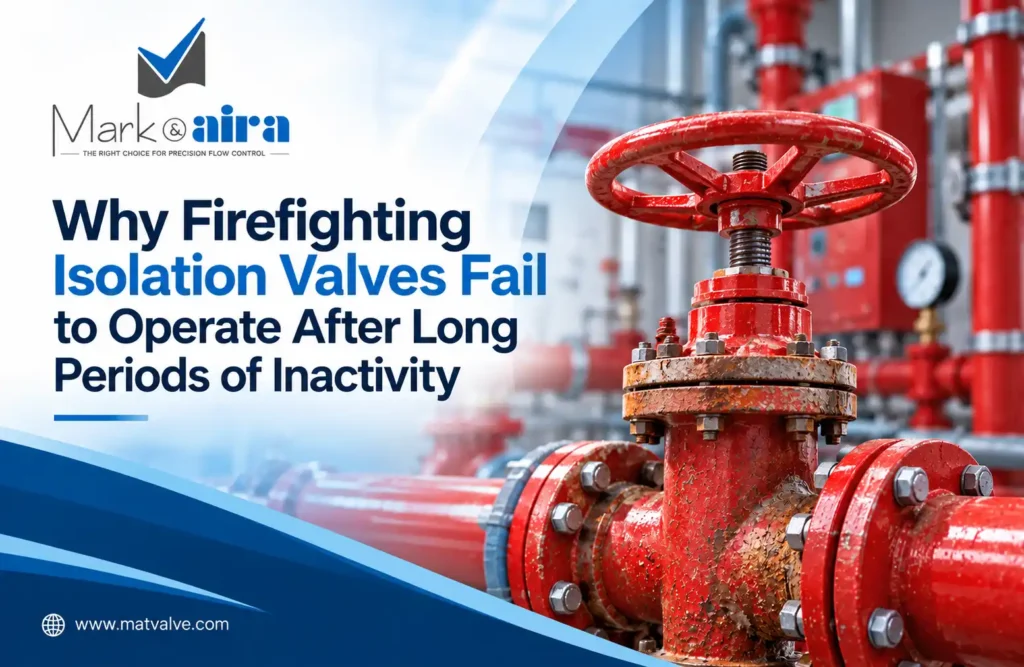
Firefighting systems in buildings spend most of their life on standby. Unlike process valves that may operate regularly, many firefighting isolation valves can remain in the same position for extended periods.
That creates an unusual reliability requirement: the valve may rarely be operated, but it must remain ready to perform when required.
Over time, corrosion, deposits, mechanical resistance, damaged operating components, or poor maintenance can make a valve difficult to operate. In some cases, the valve may also be left partially closed or in an incorrect position after maintenance.
For facility managers, fire protection contractors and MEP teams, valve reliability therefore depends not only on initial installation but also on maintaining accessibility, correct position and operability throughout the building’s life.
Why Can an Isolation Valve Become Difficult to Operate?
Long periods of inactivity can allow several problems to develop unnoticed.
Internal deposits may accumulate. Exposed components can experience corrosion. Stem or gearbox movement may become increasingly resistant. Mechanical components can deteriorate, and previous maintenance work may leave a valve in an unintended position.
The problem may remain hidden because the valve is not operated during normal building activities.
This makes inactivity different from normal wear.
A frequently operated valve may reveal increasing torque or abnormal movement relatively early. A standby isolation valve can potentially develop a problem without anyone noticing until it is inspected, tested or required for system work.
Where Are Isolation Valves Used in Building Fire Protection Systems?
Isolation arrangements depend on the building design and applicable fire protection requirements, but valves may be installed around different sections of the fire-water system.
| Building Fire Protection Area | Typical Purpose of Isolation |
|---|---|
| Fire pump connections | Allows equipment or sections to be isolated as designed |
| Sprinkler systems | Controls designated portions of the system |
| Standpipe / riser systems | Provides sectional isolation where designed |
| Fire-water tank connections | Allows equipment or piping maintenance |
| Floor or zone connections | Provides local isolation where required |
Because these valves can affect water paths through the system, their position and operating condition are important—not simply whether the valve shows visible external damage.
1. Corrosion Can Increase Operating Resistance
Fire-water systems can expose valve components to moisture for long periods.
Depending on water quality, valve material, environment and system condition, corrosion can develop internally or externally.
External corrosion may affect stems, fasteners, gearboxes, or operating components. Internal deterioration may affect surfaces that are difficult to observe during a routine visual inspection.
The first noticeable symptom may simply be that the valve becomes harder to operate.
That is why unusual operating resistance should not automatically be treated as a requirement for greater force. It may indicate a condition that needs investigation.
2. Deposits Can Develop Around Internal Components
Water remaining inside piping for extended periods can contribute to sediment, scale or corrosion-product accumulation depending on system conditions.
Deposits around valve internals may interfere with movement or prevent the closure element from travelling normally.
This can create two different problems.
A valve required to close for maintenance may not achieve the intended isolation. More importantly, a valve intended to remain open could potentially create an unintended restriction if it is not in its proper operating position.
The condition of the valve therefore matters alongside its indicated position.
3. Stems, Gearboxes and Operating Mechanisms Can Deteriorate
Not every firefighting isolation valve problem begins inside the flow path.
The operating mechanism itself can become a weak point.
A stem may corrode. A gearbox can become difficult to operate. Handwheels or other operating components can be damaged. Accessibility may also deteriorate after later building modifications or equipment installation.
Facility inspections should therefore consider a simple question:
Can the valve actually be accessed and operated as intended?
A valve installed correctly during construction is not necessarily still accessible several years later.
4. Incorrect Valve Position Can Become a Hidden Risk
Mechanical condition is only part of isolation-valve reliability.
A valve may operate perfectly but still create a problem if it has been left in an unintended position following maintenance or modification work.
For this reason, teams responsible for building fire protection systems need to consider both:
Is the valve operable?
and
Is the valve in its required normal position?
Where valve-position supervision is required by the applicable system design, code or project specification, the appropriate arrangement should be maintained and verified.
Why Using More Force Is Not Always the Answer
When an old valve becomes difficult to operate, applying substantially greater force can seem like the fastest solution.
But excessive resistance may indicate corrosion, deposits, stem problems, gearbox deterioration or internal interference.
Forcing the mechanism can damage components without addressing the underlying cause.
A better approach is to investigate why operating resistance has changed, particularly when the valve previously operated normally.
This principle is especially important for valves that have remained stationary for extended periods.
Inspection Should Look Beyond Visible Leakage
A firefighting valve does not need to be visibly leaking to deserve attention.
Inspection and maintenance programmes should consider the valve’s physical condition, accessibility, correct position, operating mechanism and any evidence of unusual resistance or deterioration.
For critical valves, maintaining records can also help identify recurring issues.
For example, if the same valve repeatedly becomes difficult to operate, simply restoring movement each time may not address the root cause. The installation environment, valve condition, material suitability or maintenance approach may require review.
Actual inspection, testing and maintenance frequencies should follow the applicable fire code, adopted standard, authority requirements and project specifications.
Procurement Considerations for Firefighting Isolation Valves
Valve selection for building fire protection should not be based only on pipe size.
Project teams should verify:
| Requirement | Why It Matters |
|---|---|
| Valve function | Confirms suitability for the intended isolation duty |
| Pressure rating | Must match system requirements |
| Materials | Should suit the service and installation environment |
| Operating mechanism | Influences accessibility and operation |
| Position indication/supervision | May be required by the system design |
| Required approvals/listings | Must meet applicable project and authority requirements |
| Installation access | Important for future inspection and maintenance |
| Documentation | Supports approval, installation and maintenance |
The applicable fire protection design requirements should always take priority over generic product selection.
Supporting Firefighting Valve Requirements in the UAE
Mark & Aira Trading supports contractors, MEP teams, consultants and procurement professionals with industrial and building-services valve solutions across the UAE.
For firefighting applications, valve requirements can be evaluated against the specified function, pressure rating, materials, operating mechanism and relevant project requirements.
Contact Mark & Aira Trading to discuss valve requirements for your building fire protection project.
Firefighting isolation valves can become difficult to operate after long periods of inactivity because of corrosion, deposits, stem or gearbox deterioration, internal resistance or maintenance-related positioning issues. Building fire protection teams should verify valve accessibility, operating condition and correct position through inspection and maintenance carried out according to applicable fire codes, standards and project requirements.