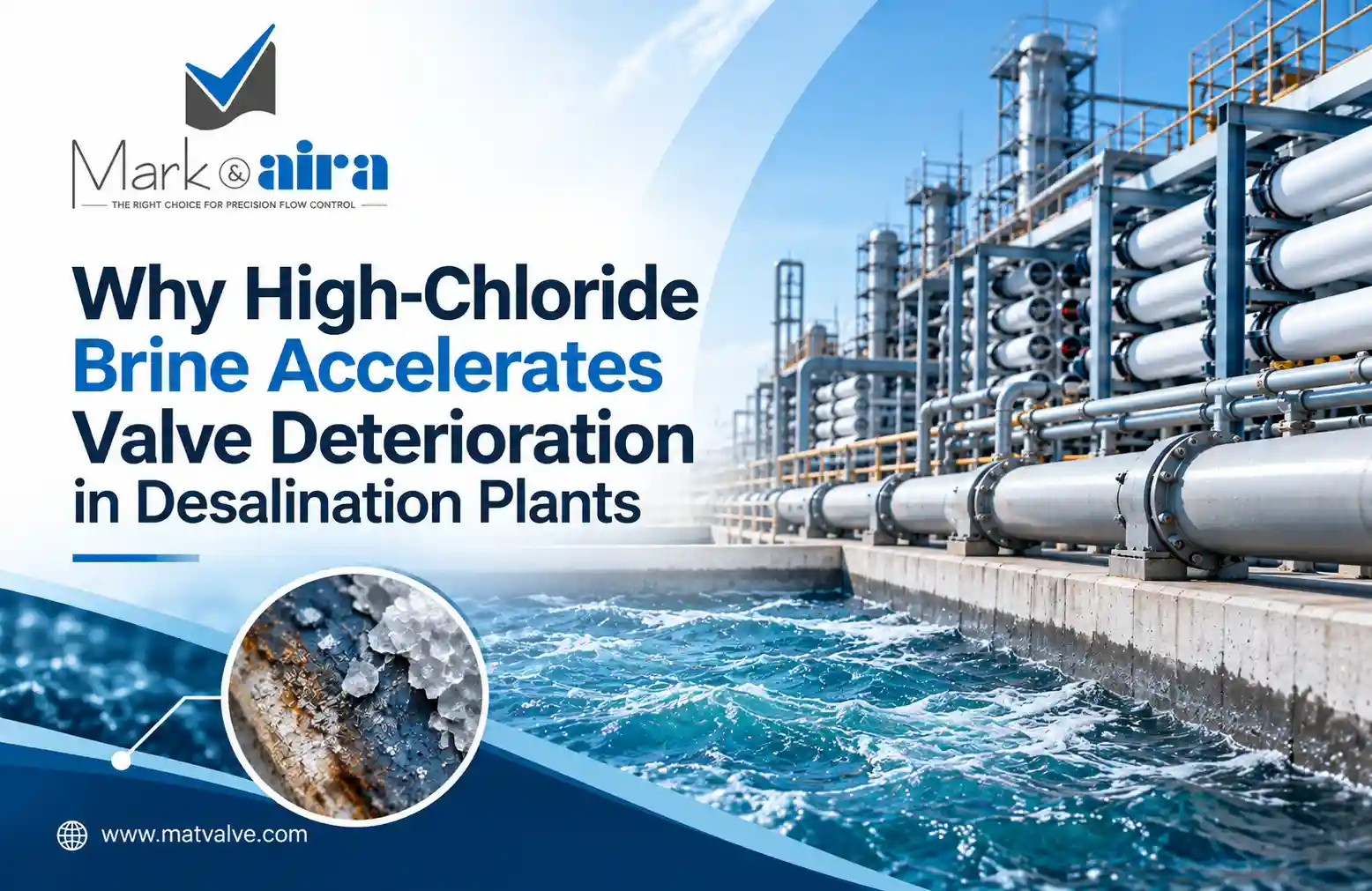
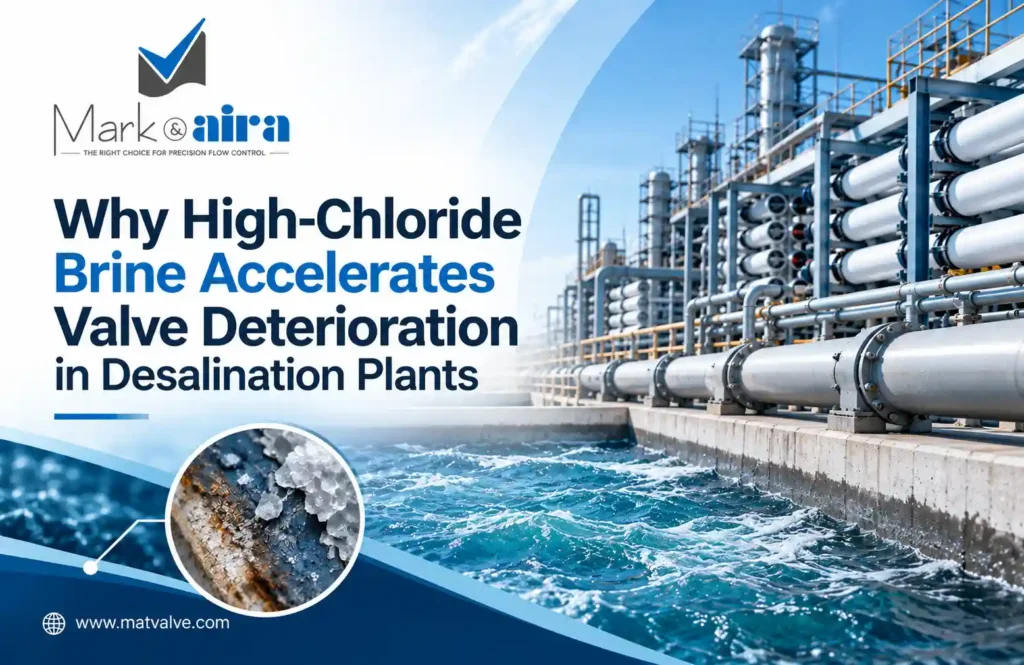
Desalination plants continuously handle fluids with very different characteristics – from incoming seawater to concentrated brine and treated water. Among these services, high-chloride brine can create particularly demanding conditions for valves and piping equipment.
As water is separated during desalination, the rejected stream becomes more concentrated than the incoming seawater. Higher salinity, combined with temperature, oxygen, flow velocity, deposits, and material selection, can increase the risk of localized corrosion and deterioration.
For desalination operators, valve reliability therefore depends on more than pressure class and size. The specific fluid environment at each stage of the plant must be considered.
Why Is High-Chloride Brine Difficult for Valves?
High-chloride environments can challenge the protective surface films that give certain metallic materials their corrosion resistance. Depending on the material and operating conditions, this can increase susceptibility to pitting, crevice corrosion and other localized forms of attack.
Brine service may become even more demanding when combined with elevated temperature, stagnant zones, deposits or high flow velocity.
This means a valve suitable for one part of a desalination plant may not automatically be suitable for concentrated brine service elsewhere in the same facility.
1. Chlorides Increase the Risk of Localized Corrosion
One of the main concerns in brine service is localized rather than uniform corrosion.
A valve may look generally acceptable while small areas around the body, seat region or internal geometry experience deeper attack.
Pitting corrosion is particularly important because localized penetration can progress without the widespread surface deterioration associated with general corrosion.
For this reason, specifying simply “stainless steel” does not provide enough information for demanding brine applications. The exact alloy grade and actual operating conditions need to be evaluated together.
2. Crevices Create Vulnerable Areas
Valve assemblies naturally contain areas where fluid movement is limited.
Potential locations include:
- Gasket interfaces
- Body joints
- Seat areas
- Flange connections
- Deposits around internal components
Fluid trapped within these narrow spaces can develop different local chemistry from the main flowing brine.
This makes crevice areas particularly important during inspection. A valve may show little external deterioration while corrosion is developing around a gasketed or internal interface.
3. Temperature Can Make Brine Service More Demanding
Chloride concentration should not be considered independently of temperature.
Material performance can change as process temperature increases, and an alloy performing adequately under one set of conditions may behave differently under hotter brine service.
Procurement specifications should therefore include the actual operating temperature range, rather than selecting a valve from chloride exposure or pressure requirements alone.
This becomes especially important when comparing materials for different stages of a desalination process.
4. Flow Conditions Influence Valve Wear
Corrosion is not the only concern.
Brine moving at high velocity can create additional problems, particularly where suspended solids are present or the valve creates localized turbulence.
Areas around the closure element and downstream surfaces may experience combined mechanical and corrosive attack. Deposits can create another challenge by producing localized conditions beneath accumulated material.
Valve selection should therefore consider:
Fluid chemistry + temperature + velocity + solids + operating duty
rather than evaluating each parameter separately.
Readers like to read:

Where Should Desalination Teams Look for Deterioration?
Inspection should focus on locations where corrosion or deposits can directly affect valve operation and sealing.
| Valve Area | What to Monitor |
|---|---|
| Internal body | Pitting, deposits and material loss |
| Seat/sealing area | Corrosion, deposits and leakage |
| Stem | Corrosion and increasing operating resistance |
| Body joints | Crevice attack and leakage |
| Flanges | Corrosion around gasketed interfaces |
| Coated surfaces | Coating breakdown or damage |
Changes in valve operating torque can also provide useful information. Increasing resistance may indicate deposits, corrosion or internal interference that deserves investigation.
Material Selection Must Match the Brine Conditions
There is no single valve material that is automatically the correct choice for every desalination application.
Depending on the chemistry, temperature, pressure and project requirements, engineers may evaluate suitable stainless-steel grades, duplex alloys, higher-alloy materials, lined valves or non-metallic solutions.
The important point is not to choose the most expensive material. It is to select a material that provides the required performance for the specific service environment.
A valve used in treated-water service, for example, may have very different material requirements from one continuously exposed to concentrated reject brine.
Can Non-Metallic or Lined Valves Help?
For suitable pressure, temperature and chemical conditions, non-metallic or lined valve designs can provide an alternative where corrosion resistance is a major concern.
However, they should not be treated as universal replacements for metallic valves.
Engineers still need to evaluate:
- Pressure and temperature limits
- Mechanical loading
- Fluid compatibility
- Valve size
- Operating frequency
- Liner or polymer suitability
- Installation conditions
This is particularly important in desalination plants because different sections of the process can have significantly different operating requirements.
Preventing Premature Brine Valve Deterioration
Improving valve life starts during specification, but maintenance remains equally important.
Operators should monitor corrosion-prone areas, maintain protective coatings where used, control deposits where practical and investigate abnormal changes in valve operation.
Repeated failure deserves deeper analysis.
If the same valve location experiences corrosion every few years, replacing it with an identical valve may only restart the same failure cycle. The engineering team should review whether the material, valve configuration, or operating conditions are responsible.
Procurement Checklist for Brine-Service Valves
Before purchasing a valve for concentrated brine service, engineering and procurement teams should verify:
| Requirement | Why It Matters |
|---|---|
| Chloride/salinity conditions | Defines the corrosive environment |
| Temperature range | Influences material performance |
| Pressure | Determines required valve rating |
| Flow velocity | Can influence erosion-corrosion |
| Suspended solids | May increase wear and deposits |
| Exact material grade | Critical for corrosion resistance |
| Seat/seal materials | Must suit fluid and temperature |
| Coating/lining | Requires service compatibility |
| Material documentation | Supports specification verification |
Providing these details allows suppliers to evaluate the application more effectively than a request based only on valve size, class and body material.
You may also like to read:

Supporting Desalination Projects in the Middle East
Mark & Aira Trading supports desalination, water treatment and industrial projects across the UAE and Middle East with metallic, lined and non-metallic valve solutions for different process conditions.
For challenging seawater and brine applications, valve selection can be evaluated against fluid chemistry, pressure, temperature, materials, and operating requirements.
Contact Mark & Aira Valves to discuss valve requirements for your desalination or water-treatment project.
High-chloride brine can accelerate valve deterioration in desalination plants by increasing the risk of localized corrosion, including pitting and crevice corrosion. Temperature, flow velocity, deposits and material selection can further influence deterioration. Reliable brine-service valve selection requires evaluating the exact alloy or valve material against fluid chemistry, temperature, pressure and operating conditions rather than specifying valve size and pressure class alone.