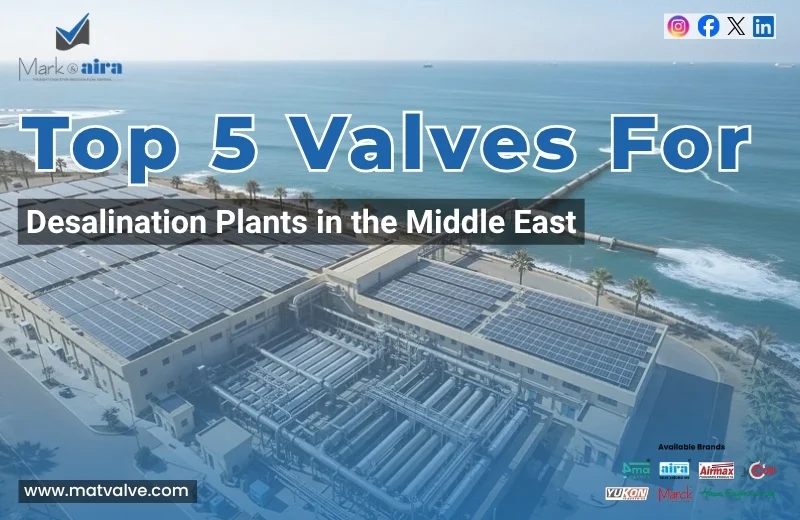
#TLDR: Desalination plants run in some of the most corrosive, high-pressure environments on earth. High salinity, chloride attack, and continuous 24/7 operation eliminate standard valve materials quickly. Here are the five valve types that perform in RO, MSF, and MED desalination systems across the UAE and GCC.
Why Desalination Valves are a Special Category?
The Middle East accounts for roughly 50% of global desalination capacity. The UAE alone operates major plants from Jebel Ali to Fujairah, supplying drinking water and industrial process water to millions of residents and facilities.
But desalination conditions destroy ordinary valves fast:
- Seawater chloride concentration: 35,000–45,000 ppm — aggressive to standard 316 stainless steel
- RO operating pressure: up to 80 bar in high-pressure feed lines
- MSF brine temperatures: 90–120°C in flash chambers
- Continuous operation: 24/7, 365 days, with minimal planned downtime
- Brine discharge: concentrated salt slurry that accelerates erosion and corrosion simultaneously
Selecting a valve for a desalination plant is not just a size-and-pressure exercise. Material grade, seat design, body configuration, and actuation method all determine whether a valve lasts one year or twenty.
1. Butterfly Valves
Primary role: Large-bore isolation and flow control in seawater intake, pre-treatment, and product water distribution lines.
Butterfly valves dominate the large-diameter pipework in desalination plants. Their compact body, low pressure drop, and fast actuation (via pneumatic or electric actuator) make them the first choice for lines from DN200 upward.
For seawater service, specify:
- Triple offset (triple eccentric) butterfly valves — metal-to-metal seating eliminates elastomer contact with corrosive seawater and handles bi-directional pressure
- Double offset butterfly valves — suitable for pre-treatment and product water lines where full metal seating is not required
- Body material: Duplex stainless steel (UNS S31803) or Super Duplex (UNS S32750) for seawater contact; ductile iron with epoxy coating for product water
Mark & Aira stocks Triple Offset Butterfly Valves and Double Offset Butterfly Valves variants with appropriate desalination-grade material options.
Actuation: Pneumatic actuators dominate desalination plants for their reliability and fail-safe operation. Electric actuators are increasingly specified for remote monitoring integration in modern SCADA-controlled plants.
2. Ball Valves
Primary role: Isolation in high-pressure RO sections, chemical dosing lines, and instrument connections.
In reverse osmosis systems, high-pressure feed water (60–80 bar) demands tight-shutoff isolation valves with low fugitive emissions. Full-bore ball valves with forged body construction meet both requirements.
For RO desalination, specify:
- Forged body ball valves over cast body — forged components have no porosity, which is critical under high-pressure seawater cycling
- Super Duplex stainless steel (UNS S32750) for high-pressure seawater contact; excellent chloride stress corrosion cracking resistance up to 300°C
- Trunnion-mounted ball valves for DN50+ in high-pressure service — seat load is supported by trunnions, not line pressure, reducing operating torque
- Anti-static and fire-safe design, where applicable per API 607
Chemical dosing lines (antiscalant, chlorine, acid) need Hastelloy or PTFE lined ball valves, depending on the dosing chemical concentration.
3. Gate Valves
Primary role: Main line isolation in seawater intake, brine discharge, and large-bore distribution pipework.
Gate valves remain the standard isolation choice for large-diameter main lines where pressure drop must be zero, and the valve is only operated during maintenance or emergencies.
For MSF and MED plants where brine temperatures reach 90–120°C:
- Class 600 or Class 900 bolted bonnet gate valves in carbon steel (with appropriate coatings) for thermal desalination service
- Knife edge gate valves for brine lines carrying suspended solids — the knife edge cuts through any particulate at the seat, preventing wedge binding
- Rising stem design with visual position indicator — critical for safe isolation confirmation in large desalination plants
UAE desalination projects commonly specify API 600 or BS 1414 gate valves for main isolation duty, with material selection per NACE MR0175 where hydrogen sulphide is present in associated utility systems.
4. Check Valves
Primary role: Pump protection and backflow prevention in feed pumps, high-pressure pumps, and product water lines.
Every pump in a desalination plant needs check valve protection. Without it, a pump trip causes reverse flow, water hammer, and potential impeller damage — a costly failure in a 24/7 process.
For desalination service:
- Swing check valves — standard for low-velocity, large-bore pipework in product water and seawater intake lines
- Dual plate wafer check valves — compact and fast-closing; preferred in high-velocity pump discharge lines where water hammer risk is high
- Tilting disc check valves — ideal for vertical pump installations in booster stations
- Non-slam check valves with spring-assisted closing — specified for RO high-pressure pump discharge to prevent pressure surge damage to membranes
Material: Duplex stainless steel for seawater contact. Bronze is acceptable for low-salinity product water service in some specifications.
5. Control Valves
Primary role: Pressure regulation in RO feed lines, flow control in product water blending, and level control in flash chambers.
Control valves are the most technically complex valves in any desalination plant. They determine membrane operating pressure in RO systems, which directly drives water recovery rate and energy consumption.
Key control valve applications:
- RO feed pressure control: Globe-pattern control valves with positioners, rated for 80+ bar. Trim material in Super Duplex or Hastelloy C276 for seawater contact.
- Pressure Relief / Pressure Sustaining Valves: Pilot-operated type for stable RO feed pressure control across variable flow conditions
- MSF level control: Cage-guided globe valves in flash chamber level applications; must handle two-phase flow (steam/brine) and high temperatures
- Chemical injection control: Small-bore needle valves or diaphragm-type control valves for precise antiscalant and biocide dosing
All control valves in critical desalination service need:
- Positioner with 4–20mA or HART communication for SCADA integration
- Fail-safe spring return actuator — fail-closed on RO feed, fail-open on bypass lines, per system safety design
- Cv sizing certified per IEC 60534 — undersized control valves cause cavitation in high-pressure seawater service
Material Selection Guide for Seawater Service
Location | Recommended Material | Reason |
Seawater intake (raw) | Super Duplex (S32750) or GRE-lined | High chloride, abrasion risk |
Pre-treatment | Duplex (S31803) or 316L | Moderate chloride |
RO high-pressure feed | Super Duplex (S32750) | High pressure + chloride |
Product water | 316L stainless or HDPE-lined | Low corrosivity |
Brine discharge | Super Duplex or Titanium | Concentrated salt + velocity |
Chemical dosing | PTFE-lined or Hastelloy C276 | Chemical resistance |
Key Certifications for UAE Desalination Projects
- API 600 / API 607 / API 6D — standard valve specifications for major UAE project procurement
- NACE MR0175 / ISO 15156 — for sour service in associated systems
- PED (Pressure Equipment Directive) — required for European-specified projects
- Lloyds / DNV Type Approval — for offshore-associated desalination (e.g., FPSO-linked units)
- ISO 9001:2015 supplier certification — mandatory for DEWA, ADWEA, and other UAE utility procurement
Mark & Aira Valves supplies all five valve categories for desalination projects across the UAE, Oman, and the wider GCC — with Dubai-based stock, full documentation, and on-site technical support. We work directly with EPC contractors and plant operators to specify the right valve for every duty point.
Get a Quote for Your Desalination Project | Industrial Valve Supplier in the UAE