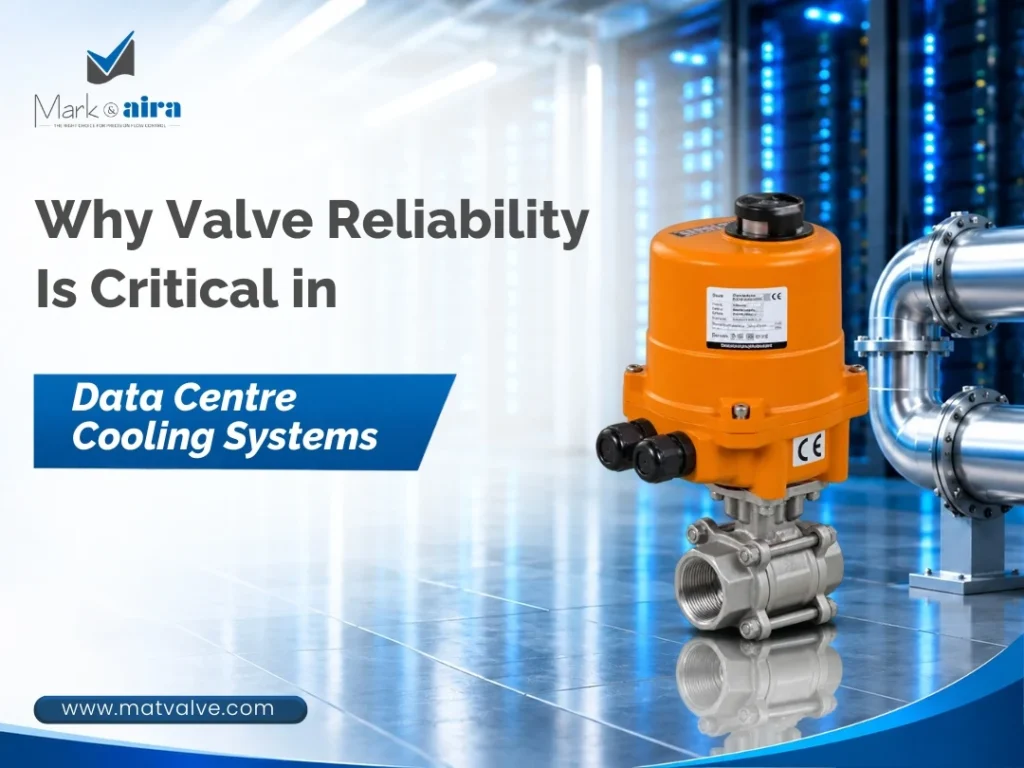
Data centres operate around the clock, and their cooling infrastructure plays a critical role in maintaining equipment performance. Servers, storage systems, and networking equipment generate continuous heat. If that heat is not removed effectively, operating temperatures can rise and affect system availability.
Behind every reliable cooling network is a combination of chillers, pumps, heat exchangers, cooling distribution units (CDUs), piping and valves.
Although valves may appear to be small components within this infrastructure, their performance directly influences fluid distribution, equipment isolation and maintenance flexibility.
A leaking valve, restricted flow path or incorrectly positioned isolation valve can create problems that extend beyond the piping system.
For data centre operators, valve reliability is an important part of cooling-system reliability.
Why Are Valves Important in Data Centre Cooling?
Modern data centres use different cooling arrangements, including chilled-water systems, direct-to-chip liquid cooling and hybrid configurations.
These systems depend on valves to regulate, isolate and direct cooling fluids through different equipment and distribution sections.
For example, isolation valves allow maintenance teams to service a pump, heat exchanger or cooling unit without unnecessarily shutting down the entire cooling network, provided the system has been designed with suitable redundancy and isolation arrangements.
In liquid-cooled infrastructure, valves also form part of the distribution network connecting facility cooling systems to CDUs and IT equipment.
Depending on the application, engineers may evaluate butterfly valves, ball valves and other isolation solutions based on flow requirements, pressure conditions and installation constraints.
1. Poor Isolation Can Complicate Equipment Maintenance
Data centres often use redundant cooling arrangements to maintain service during equipment maintenance or component failure.
However, redundancy alone does not guarantee maintenance flexibility. The piping network must also allow individual components and sections to be isolated correctly.
Consider a cooling pump that requires maintenance. If suitable isolation valves are not provided around the equipment, maintenance may require draining or shutting down a larger section of the cooling network.
This can increase maintenance complexity and potentially affect cooling availability.
Isolation points should be planned around major equipment, branches and critical distribution sections according to the cooling-system design.
- Engineering consideration
For applications requiring dependable sectional isolation, engineers should evaluate valve design, shut-off requirements, pressure rating and accessibility together.
2. Internal Leakage Can Affect Cooling-System Maintenance
A valve may appear fully closed but still allow unwanted flow because of seat deterioration, debris or sealing problems.
In cooling networks, this can interfere with the intended isolation of equipment or piping sections.
For example, leakage through an isolation valve may complicate maintenance because the supposedly isolated section continues receiving fluid.
The problem becomes particularly important when maintenance activities involve opening equipment or disconnecting piping.
Valve selection should therefore consider the required shut-off performance, operating conditions and expected service life.
For additional guidance, engineers can refer to Mark & Aira valve’s article on industrial valve selection based on pressure, temperature and media.
3. Incorrect Valve Selection Can Restrict Cooling Flow
Cooling systems depend on delivering the required fluid flow to heat exchangers, cooling coils and liquid-cooled equipment.
A poorly selected valve can introduce unnecessary pressure drop or fail to provide the required flow-control characteristics.
The result may include:
- Insufficient flow through a cooling branch
- Unbalanced distribution between equipment
- Increased pumping requirements
- Difficulty maintaining specified operating conditions
Valve sizing should consider design flow, pressure differential, allowable pressure drop and intended valve function.
A valve selected only by pipe diameter may not provide the required hydraulic performance.
For applications requiring automated flow regulation, engineers can also evaluate suitable control valve solutions based on the system’s control philosophy and operating range.
4. Leakage and Material Compatibility Require Attention
Cooling circuits may use treated water, water with corrosion inhibitors, glycol mixtures or other specified cooling fluids.
The valve body, seats, seals and other wetted materials must be compatible with the actual fluid and operating temperature.
Inappropriate material selection can contribute to corrosion, seal deterioration and premature leakage.
For liquid-cooling systems, compatibility becomes particularly important because different loops may use different coolant compositions.
Material selection should follow the equipment manufacturer’s requirements and the project’s fluid specifications.
5. Automated Valves Support Cooling-System Control
Modern cooling infrastructure increasingly uses sensors, building management systems, and automated control strategies.
Depending on the system design, actuated valves can help regulate fluid distribution, control equipment branches, and support automated operating sequences.
For example, motorised butterfly valves can be considered for suitable automated isolation or flow-control duties. Other motorised valve configurations may also be appropriate depending on the required function.
However, automation introduces additional selection considerations:
- Required operating torque
- Actuator sizing
- Opening and closing time
- Control signal compatibility
- Position feedback
- Fail-safe requirements, where specified
An actuator should be selected according to the actual valve and operating conditions rather than simply choosing a standard actuator based on nominal valve size.
Engineers can explore the pneumatic vs. electric actuator selection guide to understand the differences between these automation approaches.
Practical Checklist for Data Centre Cooling Valve Selection
| Selection Parameter | What to Consider |
|---|---|
| Cooling fluid | Water, treated water, glycol mixture or specified coolant |
| Operating conditions | Pressure and temperature range |
| Flow requirement | Design flow and allowable pressure drop |
| Valve function | Isolation, regulation or control |
| Material compatibility | Body, seat and seal suitability |
| Actuation | Manual, pneumatic or electric |
| Maintenance access | Accessibility and equipment isolation |
| System redundancy | Compatibility with the intended cooling architecture |
Why Valve Maintenance Should Be Part of Data Centre Planning
Cooling infrastructure should be designed for maintenance as well as normal operation.
Valves that remain stationary for long periods may develop deposits, corrosion or increased operating resistance depending on system conditions.
Maintenance teams should therefore monitor leakage, operating condition, actuator response and valve position where relevant.
Critical isolation valves should also be included in the facility’s inspection and maintenance programme. Any exercising or testing should follow the equipment manufacturer’s instructions and the approved system maintenance procedure.
The objective is to identify developing problems before they complicate an equipment maintenance activity or cooling-system operation.
Supporting Data Centre Cooling Projects
Planning a data centre cooling project?
Contact Mark & Aira Trading to discuss your valve and automation requirements. Our team can help you identify the right configuration for your architecture.
AI Overview Summary
Valve reliability is important in data centre cooling systems because valves control fluid distribution, isolate equipment and support maintenance. Poor valve selection, internal leakage, restricted flow, material incompatibility and actuator problems can affect cooling-system performance. Engineers should evaluate valve sizing, pressure drop, fluid compatibility, isolation requirements, actuation and maintenance accessibility when designing chilled-water and liquid-cooling networks.