#TLDR: Pneumatic actuators are fast, rugged, and fail-safe — the default choice for ATEX hazardous zones and fast-cycling applications. Electric actuators offer precision, data feedback, and lower energy cost — making them the better fit for modern automation and non-hazardous process control. The right choice depends on your application, not brand preference.
How Each Technology Works?
Pneumatic actuators convert compressed air pressure into mechanical motion. A spring-return mechanism provides fail-safe operation — when air supply is lost, the spring pushes the valve to a predetermined safe position (fail-open or fail-closed). This fail-safe characteristic is the primary reason pneumatic actuators dominate oil & gas and chemical plants.
Electric actuators use an electric motor (AC or DC) driving a gearbox to produce torque. They require electrical power to operate and a separate fail-safe battery backup or spring-return mechanism if fail-safe action is needed. In return, they offer superior position feedback, programmable speeds, and digital communication (4–20mA, HART, Profibus, Modbus).
Speed and Force Comparison
Parameter | Pneumatic | Electric |
Stroke speed | Fast — under 1 second for quarter-turn | Slower — typically 5–30 seconds |
Force / torque output | High — scales easily with bore size | Moderate — large torques require larger gear trains |
Speed control | Limited — requires flow control valves | Precise — programmable ramp-up/ramp-down |
Emergency shutoff | Excellent — spring return in <1s | Requires battery-backed system |
For emergency shutdown valves (ESDVs) and safety instrumented systems (SIS), pneumatic actuators are almost always specified. The sub-second closure time and inherent fail-safe action meet SIL 2 and SIL 3 requirements without complex electrical backup systems.
ATEX and Hazardous Area Considerations in UAE Plants
Most UAE oil & gas, petrochemical, and offshore facilities contain ATEX Zone 1 and Zone 2 classified areas where explosive atmospheres can exist. Introducing an ignition source in these zones is a regulatory violation and a serious safety risk.
Pneumatic actuators have a natural advantage here. No electrical components contact the hazardous area — only instrument air tubing and a solenoid valve (which can be mounted in a safe area). This eliminates spark ignition risk entirely and simplifies ATEX compliance.
Electric actuators in ATEX zones require specially certified explosion-proof motor enclosures (ATEX II 2G, IECEx), which increases unit cost, weight, and maintenance complexity. They are used in ATEX zones but at higher cost and with more demanding inspection requirements.
For UAE plants in the Abu Dhabi Oil District, ADNOC-affiliated refineries, or any ADGAS / GASCO facility: confirm ATEX Zone classification before specifying electric actuators on process valves.

Total Cost of Ownership
The upfront cost comparison favours pneumatic actuators. But total cost of ownership (TCO) over a 10–15 year plant life tells a different story.
Cost Element | Pneumatic | Electric |
Purchase price | Lower | Higher (20–40% premium) |
Installation | Requires compressed air infrastructure | Requires electrical supply |
Energy consumption | High — compressed air is energy-inefficient (only ~10% of input energy does useful work) | Low — electric motors convert 85–95% of input energy |
Maintenance | Seal and diaphragm replacement every 3–5 years; filter/regulator servicing | Gearbox lubrication; minimal seal work |
Diagnostics | Limited without positioner | Full position feedback and fault logging standard |
10-year TCO (typical) | Higher for high-cycle applications | Lower for precision / continuous duty |
UAE plants with existing compressed air infrastructure often find pneumatic actuators cheaper to operate in the short term. New facilities being designed today — particularly those targeting energy efficiency targets under UAE Net Zero 2050 — are increasingly specifying electric actuation on non-hazardous process valves.
Precision and Control Feedback
Electric actuators are the clear winner on precision. Modern units deliver:
- Position accuracy: ±0.5% of span — significantly tighter than pneumatic positioners (typically ±1–2%)
- HART / Profibus / Modbus communication — real-time valve position, torque data, and fault alerts transmitted directly to the plant DCS or SCADA system
- Partial stroke testing (PST) without process interruption — critical for SIL-rated valves in safety systems
Pneumatic actuators with smart positioners close the gap significantly. A pneumatic actuator fitted with a HART-capable digital positioner provides position feedback, PST capability, and diagnostics at the cost of added complexity and a separate instrument air supply.
For pharma plants and fine chemical facilities — where precise throttling, repeatable dosing, and full audit trails are regulatory requirements — electric actuators with digital positioners are the standard specification.
Maintenance Requirements
Pneumatic Actuator:
- Filter/regulator/lubricator (FRL) units require regular inspection and element changes
- Diaphragm or piston seals wear over high-cycle duty — typically every 3–5 years depending on cycle count
- Solenoid valve coils are a common failure point
- Air quality matters: wet or contaminated instrument air accelerates seal degradation rapidly
Electric Actuator:
- Fewer consumable parts — primarily gearbox lubrication and motor bearing checks
- Motor winding insulation degrades in high-temperature environments (above 40°C ambient) — UAE plants must specify appropriate thermal class motors (Class F or H)
- Battery backup systems (for fail-safe electric actuators) require periodic battery replacement and testing
Overall, electric actuators carry lower long-term maintenance burden in controlled environments. Pneumatic actuators are more tolerant of harsh field conditions if the instrument air supply is well-maintained.
When to Choose Pneumatic Actuator
- ATEX Zone 1 or Zone 2 hazardous areas
- Emergency shutdown duty requiring sub-second closure
- High cycle rate applications (100+ cycles per day)
- Sites with existing compressed air infrastructure
- SIL 2/3 safety instrumented functions requiring inherent fail-safe
- Large-bore valves where electric torque output is limiting
- Budget-constrained projects without SCADA integration requirements
- Pneumatic actuators are often preferred for fail-safe emergency systems because of their rapid response capability.
When to Choose Electric Actuator
- Non-hazardous areas (safe area or ATEX Zone 2 with appropriate certification)
- Applications requiring precise throttling and position feedback
- Remote or unmanned sites where compressed air generation is impractical
- Plants targeting energy efficiency improvements
- Modulating control duty (4–20mA signal, continuous positioning)
- IIoT and smart plant integration (HART, Profibus, Foundation Fieldbus)
- Pharmaceutical, food, or cleanroom applications where hygiene and precision are critical
Industry-by-Industry Guide for the UAE
Industry | Recommended Actuator | Reason |
Oil & Gas upstream / offshore | Pneumatic | ATEX zones, ESD duty, fail-safe requirement |
Petrochemicals | Pneumatic (primary) + Electric (control loops) | Mix of hazardous zones and precision control |
Power Plants | Both — pneumatic for steam isolation, electric for control valves | Varied duty in same plant |
Pharmaceuticals | Electric | Precision, audit trail, clean room compliance |
Desalination | Both — pneumatic for main isolation, electric for SCADA-controlled modulating valves | Remote operation + energy efficiency |
Water & Wastewater | Electric (increasingly) | Energy efficiency targets, remote monitoring |
Steel Plants | Pneumatic | High-temperature environment, fast cycling |
Decision Matrix
Score your application across these five factors:
Factor | Pneumatic Score | Electric Score |
Hazardous area (ATEX) | +3 | -1 |
Fast emergency shutoff needed | +3 | 0 |
Precision throttling needed | 0 | +3 |
Energy efficiency priority | -1 | +3 |
Remote diagnostics / IIoT | 0 | +3 |
Existing air infrastructure | +2 | 0 |
High cycle rate (100+/day) | +2 | 0 |
No air infrastructure on site | -2 | +3 |
The option with the higher total score for your specific conditions is your right answer. Most large UAE plants end up with both technologies — pneumatic on process isolation and ESD duty, electric on modulating control and utility applications.
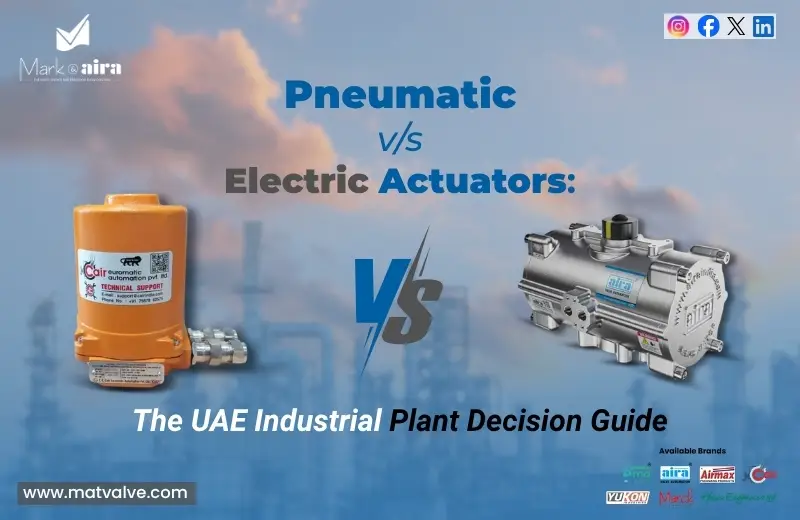
Mark & Aira Valves supplies pneumatically and electrically actuated valves from leading brands, including Cair’s Electric Actuators and aira’s Pneumatic Actuators— stocked in Dubai for fast UAE delivery with full technical support.
Frequently Asked Questions
Which actuator is better for ATEX-certified hazardous zones in the UAE?
Pneumatic actuators are the industry standard for ATEX Zone 1 and 2 environments (common in ADNOC and petrochemical facilities). Because they operate on compressed air rather than electricity, they pose no risk of spark ignition. While explosion-proof electric actuators exist, they are significantly more expensive and require more complex maintenance to remain compliant.
Can electric actuators provide the same fail-safe protection as pneumatic ones?
Yes, but it requires additional components. Pneumatic actuators have an inherent fail-safe via mechanical springs (spring-return) that trigger instantly if air pressure is lost. Electric actuators require a battery backup system or a specialized internal spring-return motor to achieve the same result, which adds to the unit’s cost and weight.
How does the UAE’s high ambient temperature affect actuator choice?
In the UAE, where temperatures often exceed 40°C, electric actuators must be specified with high-grade thermal insulation (Class F or H motors) to prevent burnout. Pneumatic actuators are generally more resilient to heat, though the elastomer seals inside them may degrade faster in extreme desert conditions and require high-temp Viton seals for longevity.
Why are electric actuators preferred for pharmaceutical valve selection?
Pharmaceutical and fine chemical plants prioritize precision, hygiene, and data logging. Electric actuators provide high-accuracy positioning (±0.5%) and digital feedback (HART/Modbus), allowing for automated dosing and a digital “audit trail” that is essential for regulatory compliance and batch consistency.
Which technology offers a lower Total Cost of Ownership (TCO)?
While pneumatic actuators are cheaper to purchase upfront, they are less energy-efficient because compressed air systems leak and require significant power to run. Electric actuators have a lower TCO over 10–15 years because they only consume power during movement and offer better diagnostic data, reducing unplanned downtime and energy waste.