Pulp and paper manufacturing involves handling fibrous materials, water, chemicals and suspended solids throughout different stages of production.
Unlike clean-water applications, pulp slurry contains fibres that can accumulate around valve internals, interfere with movement and affect sealing performance. Depending on fibre concentration, consistency and process conditions, these issues can increase maintenance requirements and interrupt production.
Valves installed in pulp processing lines must therefore handle more than fluid pressure. They must also perform reliably when the process media contains suspended fibres and other contaminants.
For plant engineers and maintenance teams, understanding how fibre accumulation affects valve performance is essential for reducing unexpected downtime.
Why Is Pulp Slurry Difficult for Industrial Valves?
Pulp slurry is a mixture of water and fibrous material. Its consistency and flow behaviour can vary depending on the production stage and operating conditions.
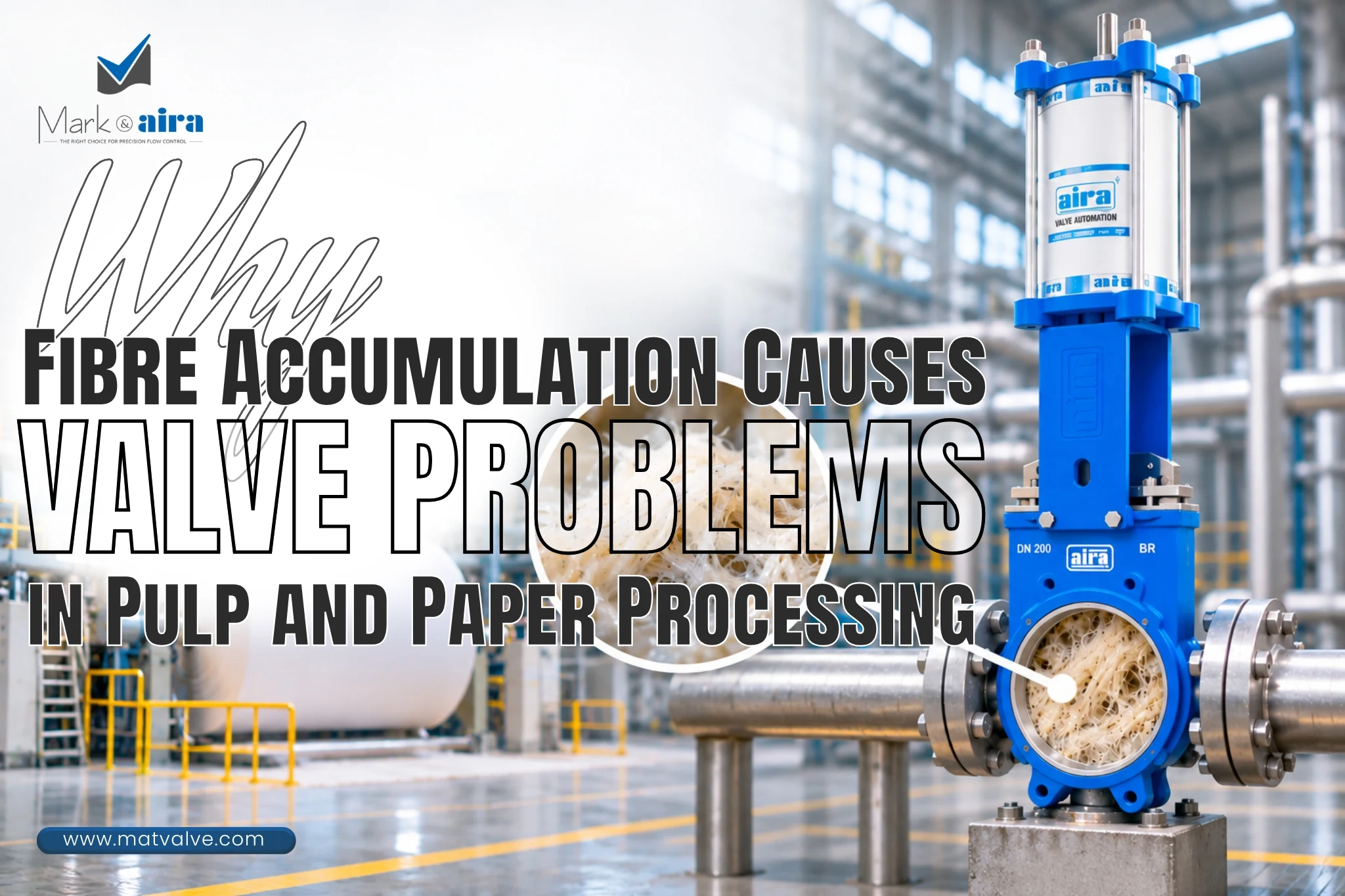
Fibres may collect around internal components, particularly where the valve design creates restricted passages, dead spaces or areas with limited fluid movement.
Over time, accumulated material can contribute to:
- Restricted flow passages
- Incomplete valve closure
- Increased operating resistance
- Seat contamination
- More frequent cleaning and maintenance
This makes selecting the right industrial valve for slurry applications particularly important in pulp preparation, stock handling and other fibre-containing process lines.
1. Fibre Build-Up Can Interfere with Valve Closure
One of the common challenges in fibrous-media service is material collecting around the closure element or sealing area.
When the valve is operated, accumulated fibres may prevent the closure element from reaching its intended position. This can result in incomplete closure or internal leakage.
The problem is particularly relevant where the process contains higher fibre concentrations or where flow conditions allow material to accumulate.
Engineering consideration: Valve selection should account for the nature of the slurry, potential fibre accumulation and the geometry of the internal flow passage.
For suitable applications, engineers can evaluate a Bi-Directional Knife Edge Gate Valve. Its product specifications identify pulp and paper among its intended media applications. Final suitability should still be confirmed against the actual process conditions.
2. Accumulated Fibres Can Increase Operating Resistance
Fibres and suspended solids can collect around moving components depending on valve design and process conditions.
This may increase the resistance encountered during opening or closing.
In automated installations, increased resistance can also affect actuator performance if the valve requires more torque than originally anticipated.
Maintenance teams should investigate unusual changes in operating torque rather than immediately increasing actuator output.
The underlying cause may be fibre accumulation, internal interference or wear. For a deeper understanding, refer to Mark & Aira Trading Valve’s guide on Valve Torque Calculation Explained for Engineers.
3. Restricted Flow Can Affect Production Consistency
Pulp processing depends on maintaining suitable flow through different production stages.
If fibres accumulate within a valve or partially obstruct the flow path, the system may experience additional pressure drop or inconsistent flow distribution.
Depending on the process location, this can affect downstream equipment and production stability.
Valve sizing and internal configuration should therefore consider actual slurry characteristics rather than relying only on nominal pipe diameter.
The selection process should also account for pressure, temperature and media conditions to ensure the valve is suitable for the intended operating environment.
4. Abrasive Contaminants Can Accelerate Internal Wear
Not all pulp slurry contains only soft fibres.
Depending on the process, suspended mineral particles, sand, fillers and other contaminants may also be present.
These materials can contribute to wear around internal surfaces and sealing components, particularly under demanding flow conditions.
Repeated exposure can gradually affect sealing performance and increase maintenance requirements.
Engineers should evaluate the actual composition of the process stream before selecting materials and valve construction. The valve’s internal design must also be suitable for the solids and flow conditions.
Which Valve Designs Should Engineers Evaluate?
Valve suitability depends on slurry consistency, fibre length, solids content, pressure, temperature and the required operating function.
For certain pulp and fibre-handling applications, engineers may evaluate knife gate valves because they are designed for suitable slurry and solids-handling duties.
Mark & Aira Trading Valve’s Bi-Directional Knife Edge Gate Valve is one product option to evaluate for this industry. Its published specifications include multiple body, disc and seat material options, with application suitability dependent on the actual service conditions.
The important consideration is not selecting a valve simply because it is marketed for industrial service. Its internal geometry, sealing arrangement and operating capability must match the actual application.
Practical Checklist for Pulp and Paper Valve Selection
| Selection Parameter | What to Consider |
|---|---|
| Process media | Pulp slurry, water and other process fluids |
| Fibre concentration | Potential for accumulation |
| Solids content | Presence of abrasive contaminants |
| Operating pressure | Required pressure rating |
| Temperature | Normal and design conditions |
| Valve function | Isolation or flow regulation |
| Internal design | Suitability for fibrous media |
| Actuation | Required operating torque |
| Maintenance access | Cleaning and inspection requirements |
How Can Maintenance Teams Reduce Fibre-Related Valve Problems?
Valve reliability depends on more than initial selection.
Maintenance teams should monitor operating resistance, inspect areas prone to accumulation and investigate recurring internal leakage.
Where fibre build-up is repeatedly observed, the team should review whether the valve configuration is appropriate for the process.
Simply cleaning the same valve repeatedly may not solve the problem if its internal design or installation creates conditions that encourage accumulation.
For valves that become difficult to operate after extended service, understanding the causes of valve seizure and operating resistance can help maintenance teams investigate the underlying issue.
Tracking recurring blockages, operating torque changes, and maintenance history can help identify valves that require a different configuration.
Supporting Pulp and Paper Industry Applications
Mark & Aira Trading supports industrial process applications across the UAE and Middle East with valve solutions for different operating conditions.
For pulp and paper projects, valve selection can be evaluated against fibre concentration, suspended solids, operating pressure, temperature, isolation requirements and actuation needs.
The objective is to identify a suitable valve configuration for the actual process rather than selecting equipment based only on line size.
Planning a pulp or paper processing project? Contact Mark & Aira Trading to discuss your industrial valve requirements.