When people think about cement manufacturing, they often focus on kilns, clinker production, and grinding mills. However, an equally important part of every cement plant is the powder handling system that moves raw materials and finished cement efficiently throughout the facility.
From cement silos and fly ash storage to screw conveyors and bulk loading stations, thousands of tonnes of fine powder are transferred every day. Any interruption in this flow can affect production schedules, increase housekeeping requirements, and create unnecessary maintenance challenges.
Unlike liquids, cement powder behaves differently during storage and conveying. Fine particles can bridge inside hoppers, generate airborne dust, build up around equipment, or leak from poorly sealed isolation points. These challenges become more significant in plants operating continuously, where even a short interruption can impact overall productivity.
Reliable flow control is therefore essential—not only for maintaining production efficiency but also for reducing dust emissions, improving workplace safety, and protecting downstream equipment.
This is where cement butterfly valves play an important role. Installed beneath silos, hoppers, screw conveyors, and pneumatic conveying systems, they help isolate and regulate the movement of dry bulk materials while supporting efficient material transfer across the plant.
In this article, we’ll explore the challenges of powder handling in cement plants, why specialised butterfly valves are commonly used in these systems, and the engineering considerations that help improve long-term reliability.
What Role Does a Cement Butterfly Valve Play in Powder Handling Systems?
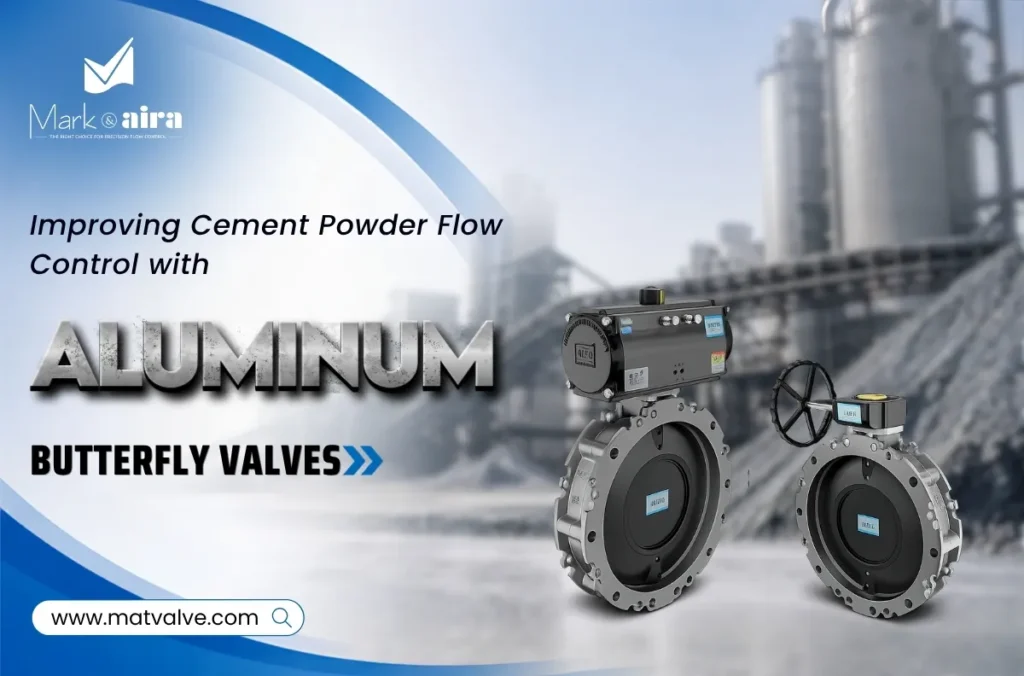
A cement butterfly valve is designed to control or isolate the flow of dry bulk materials such as cement powder, fly ash, lime, and mineral fillers in storage and conveying systems. Installed beneath silos, hoppers, and screw conveyors, it helps maintain controlled material discharge while reducing dust leakage and supporting efficient plant operation. Selecting the correct valve design, seal material, and actuation method contributes to improved reliability, easier maintenance, and more consistent powder flow.
Understanding Powder Handling in Cement Plants
Before cement reaches a truck, bulk tanker, or packaging line, it passes through several storage and conveying stages.
After the grinding process, cement is transferred to storage silos, where it remains until required for packing or bulk dispatch. Throughout this journey, the material must move smoothly without excessive dust generation or interruptions.
A simplified powder handling process typically looks like this:
Grinding Mill
↓
Cement Storage Silo
↓
Discharge Hopper
↓
Butterfly Valve
↓
Screw Conveyor / Pneumatic Conveyor
↓
Packing Plant or Bulk Loading
Although this flow appears straightforward, each transfer point introduces engineering challenges that must be carefully managed.
Why Powder Handling Is More Challenging Than Liquid Flow
Unlike water or other liquids, cement powder does not always flow uniformly.
Its behaviour depends on factors such as particle size, moisture content, bulk density, and storage conditions. As a result, operators must manage issues that are unique to dry bulk materials.
Powder Handling Challenge | Operational Impact |
Dust leakage | Product loss and housekeeping issues |
Material bridging | Interrupted discharge from silos |
Powder build-up | Increased maintenance requirements |
Uneven material flow | Reduced process efficiency |
Air leakage | Lower pneumatic conveying performance |
These issues can reduce production efficiency if isolation and discharge equipment is not properly selected or maintained.
Engineering Insight
In cement plants, reliable production depends as much on efficient powder handling as it does on grinding and clinker production. Well-designed material flow systems help minimise dust, improve process stability, and reduce maintenance across the entire conveying line.
Where Are Butterfly Valves Used in Cement Plants?
Butterfly valves are installed at multiple points throughout a cement plant where dry bulk materials need to be isolated or discharged in a controlled manner. Their compact design, quarter-turn operation, and ability to integrate with manual or pneumatic actuation make them well suited for powder handling systems.
Rather than serving a single process, these valves support material movement across several stages of production.
Process Area | Typical Function of Butterfly Valve |
Cement Storage Silos | Controls material discharge from the silo |
Fly Ash & Lime Silos | Isolates storage and feeding systems |
Screw Conveyors | Regulates material entering the conveyor |
Pneumatic Conveying Systems | Isolates conveying lines during operation or maintenance |
Packing Plants | Controls cement flow before packaging |
Bulk Loading Systems | Regulates material transfer into tankers or bulk trucks |
Each application has different operating requirements, but the objective remains the same—maintaining consistent powder flow while reducing dust leakage and simplifying maintenance.
Silo Discharge Systems
Storage silos are designed to hold large volumes of cement powder before it is transferred to the next stage of production.
At the bottom of the silo, butterfly valves regulate material discharge into screw conveyors or pneumatic conveying systems.
The valve must operate reliably despite continuous exposure to fine cement particles, which can accumulate around sealing surfaces over time.
Poor isolation at this point may result in:
- Uncontrolled material discharge
- Dust emissions
- Material wastage
- Difficult maintenance activities
Screw Conveyor Feeding
Screw conveyors are widely used to transport cement powder over short distances inside processing plants.
Butterfly valves installed upstream allow operators to isolate the conveyor during inspection or maintenance without emptying the entire storage system.
This helps minimise production interruptions and improves maintenance safety.
Pneumatic Conveying Systems
Many cement plants use pneumatic conveying to transport cement powder, fly ash, and other dry bulk materials between process areas.
These systems depend on controlled airflow and sealed conveying lines.
Butterfly valves assist by:
- Isolating conveying pipelines
- Supporting maintenance activities
- Preventing unwanted material flow
- Helping maintain system efficiency
Reliable sealing becomes particularly important because even small air leaks can reduce conveying performance and increase energy consumption.
Packing Plants and Bulk Loading
Before cement reaches bags or bulk tankers, the flow rate must remain stable to support accurate filling and minimise dust generation.
Butterfly valves help isolate discharge points during maintenance while providing dependable control during normal plant operation.
For facilities operating around the clock, reliable isolation reduces production delays and simplifies routine servicing.
Why Butterfly Valves Are Commonly Selected for Powder Handling
Cement plants use different valve types depending on the application, but butterfly valves are widely preferred for handling dry bulk materials because they combine compact construction with reliable isolation and straightforward operation.
Their design makes them particularly suitable for equipment installed beneath silos, hoppers, and conveying systems where installation space is often limited.
Some of the reasons engineers commonly specify butterfly valves include:
- Compact face-to-face dimensions
- Quarter-turn operation for faster opening and closing
- Simple integration with pneumatic actuators
- Lower maintenance requirements compared with more complex valve designs
- Reliable isolation for cement powder, fly ash, lime, and similar dry materials
The goal is not simply to control material flow, but to do so consistently while supporting plant uptime and maintenance efficiency.
Why Aluminum Butterfly Valves Are Well Suited for Cement Applications
For dry powder handling, the valve body material influences installation, maintenance, and long-term performance.
Aluminum butterfly valves are widely used in cement and bulk material handling systems because they offer a practical balance between strength, weight, and corrosion resistance.
Compared with heavier metallic alternatives, aluminum bodies are easier to install, particularly on elevated silos, compact conveying equipment, and modular processing systems.
Engineering advantages include:
Design Feature | Operational Benefit |
Lightweight aluminum body | Easier installation and reduced structural load |
Corrosion resistance | Suitable for industrial environments with airborne dust and moisture |
Compact construction | Fits easily beneath silos and hoppers |
Pneumatic actuator compatibility | Supports automated powder handling systems |
Low maintenance design | Simplifies routine servicing and inspection |
The suitability of an aluminum body still depends on the operating environment, process pressure, and media characteristics. Engineers should always evaluate the complete application before selecting the appropriate valve specification.
Engineering Insight
In cement plants, valve selection should begin with the material handling process—not the valve catalogue. Understanding how cement powder behaves during storage, discharge, and conveying helps engineers choose equipment that delivers reliable isolation, easier maintenance, and longer service life.
Common Powder Handling Challenges and Their Impact on Valve Performance
Even in well-designed cement plants, powder handling systems are exposed to conditions that gradually affect valve performance. Unlike liquid systems, dry bulk materials behave differently depending on particle size, moisture, storage conditions, and conveying methods.
If these challenges are not addressed, valves may require frequent maintenance, experience premature wear, or affect the overall efficiency of the material handling process.
The table below summarises the most common operational issues.
Challenge | Likely Cause | Operational Impact |
Dust leakage | Worn seals or improper valve closing | Material loss and poor housekeeping |
Material build-up | Fine powder accumulation around the disc | Difficult valve operation |
Bridging or arching | Poor hopper discharge characteristics | Interrupted material flow |
Air leakage | Inadequate sealing in pneumatic systems | Reduced conveying efficiency |
Frequent maintenance | Incorrect valve selection or operating conditions | Higher operating costs and downtime |
Understanding these problems helps maintenance teams focus on improving the overall material handling system rather than simply replacing worn components.
Dust Leakage Around Discharge Points
Dust control is one of the biggest operational concerns in cement manufacturing.
When valves fail to provide effective isolation, fine cement particles can escape during material transfer. Besides product loss, dust leakage increases housekeeping requirements and may affect workplace safety and surrounding equipment.
Maintaining seal integrity and regularly inspecting valve condition are important steps in reducing unnecessary dust emissions.
Material Build-Up
Fine cement powder has a tendency to accumulate around moving equipment, particularly where material flow is interrupted or discharge is inconsistent.
Over time, this build-up can:
- Increase operating resistance
- Restrict disc movement
- Affect sealing performance
- Increase maintenance frequency
Routine cleaning during scheduled shutdowns helps prevent excessive accumulation before it begins to affect valve operation.
Air Leakage in Pneumatic Conveying Systems
Pneumatic conveying systems depend on controlled airflow to transport cement powder efficiently.
If isolation valves do not maintain proper sealing, unwanted air leakage can reduce conveying performance, increase energy consumption, and affect material transfer rates.
Although the leakage may initially appear insignificant, its cumulative effect can influence the efficiency of the entire conveying system.
Engineering Strategies for Reliable Powder Flow
Improving powder handling reliability involves more than selecting the correct valve. It requires considering how the valve interacts with the silo, hopper, conveying equipment, and operating conditions.
The following engineering practices help improve long-term system performance.
Select the Valve Based on the Material Being Handled
Not all dry bulk materials behave the same way.
Before selecting a butterfly valve, engineers should evaluate:
- Particle size distribution
- Bulk density
- Moisture content
- Flow characteristics
- Abrasiveness
- Operating temperature
These characteristics influence sealing performance, operating torque, and overall valve reliability.
Selecting equipment based solely on pipe size or flange dimensions often leads to unnecessary maintenance issues later.
Match the Actuation Method to Plant Operations
The operating method should reflect how frequently the valve is used and how it integrates with the plant’s control system.
Typical options include:
Actuation Method | Typical Application |
Manual lever | Small silos and low-cycle applications |
Gear operator | Larger valve sizes requiring higher operating torque |
Pneumatic actuator | Automated conveying and batching systems |
Electric actuator | Remote operation and process automation |
Choosing the appropriate actuation method improves operational efficiency while reducing unnecessary wear caused by improper operation.
Maintain Proper Hopper and Silo Design
Valve performance is closely linked to the design of the equipment above it.
Poor hopper geometry can create uneven material discharge, causing bridging or excessive loading on the valve.
When designing or upgrading powder handling systems, engineers should consider:
- Hopper outlet dimensions
- Material flow angle
- Consistent discharge patterns
- Prevention of stagnant material zones
Optimising the complete discharge system helps improve both material flow and valve reliability.
Preventive Maintenance Best Practices
Preventive maintenance is significantly more effective than waiting for visible leakage or flow problems.
Routine inspections allow maintenance teams to identify wear before it begins affecting production.
Recommended Inspection Checklist
Inspection Item | Suggested Frequency |
External dust leakage | Weekly visual inspection |
Disc movement | Monthly |
Seal condition | Every 3 months |
Pneumatic actuator operation | Planned shutdown |
Mounting hardware | Planned shutdown |
Complete functional inspection | Annual or major turnaround |
Inspection intervals should always be adjusted according to operating hours, powder characteristics, and plant maintenance practices.
Procurement Considerations for Cement Butterfly Valves
Selecting a butterfly valve for cement powder handling involves evaluating the complete operating environment—not simply comparing catalogue specifications.
Before finalising a purchase, procurement teams should verify the following:
Evaluation Criteria | Why It Matters |
Compatibility with cement and dry powders | Ensures reliable long-term operation |
Body and seal materials | Suitable for operating conditions |
Connection standard | Matches existing equipment |
Actuation compatibility | Supports current or future automation |
Ease of maintenance | Reduces servicing time during shutdowns |
Supplier technical support | Assists with application-specific selection |
Considering these factors during procurement helps reduce lifecycle costs while improving plant reliability and maintainability.
Engineering Insight
Reliable powder handling is achieved through system design, not just valve selection. When silo geometry, conveying equipment, valve specification, and maintenance practices work together, cement plants experience smoother material flow, reduced dust emissions, and longer equipment life.
Future Trends in Cement Powder Handling Systems
Cement manufacturing is becoming increasingly automated as plants focus on improving production efficiency, reducing emissions, and lowering maintenance costs. Modern powder handling systems are no longer viewed as isolated equipment—they are becoming integrated parts of a digitally connected production process.
This shift is influencing how flow control equipment, including butterfly valves, is selected, monitored, and maintained.
Automation in Material Handling
Today’s cement plants rely heavily on automated conveying and batching systems to maintain consistent production.
As automation increases, butterfly valves are expected to integrate seamlessly with plant control systems, allowing operators to monitor and control material flow remotely.
Key developments include:
- Pneumatic valve automation
- PLC and DCS integration
- Remote operation from central control rooms
- Faster response during production changes
- Improved process consistency
Automation not only improves operational efficiency but also reduces manual intervention in dusty process areas.
Smarter Maintenance Practices
Instead of servicing valves only after problems occur, many facilities are adopting condition-based maintenance.
By monitoring equipment performance over time, maintenance teams can identify early signs of wear and schedule maintenance during planned shutdowns.
Typical monitoring activities include:
- Valve operating cycles
- Actuator performance
- Opening and closing response
- External leakage inspections
- Seal condition assessments
This proactive approach helps minimise unexpected downtime while extending equipment service life.
Key Takeaways
Before selecting butterfly valves for cement powder handling systems, remember these engineering principles:
✔ Powder handling performance depends on the complete conveying system—not only the valve.
✔ Dust leakage, material build-up, and bridging are common challenges that should be considered during system design.
✔ Valve selection should be based on powder characteristics, operating conditions, and automation requirements.
✔ Preventive inspections and routine maintenance help improve reliability and reduce unplanned shutdowns.
✔ Selecting equipment with long-term maintenance and operational efficiency in mind provides greater lifecycle value than focusing solely on purchase price.
Conclusion
Efficient powder handling is essential for maintaining productivity in modern cement plants. From storage silos and screw conveyors to pneumatic conveying systems and bulk loading stations, every stage depends on reliable material flow and effective isolation.
Although butterfly valves represent only one part of the material handling system, their performance directly influences production continuity, dust control, maintenance efficiency, and overall plant reliability.
Understanding powder behaviour, selecting equipment suitable for the application, and implementing a proactive maintenance strategy can significantly improve system performance while reducing operational costs.
As cement plants continue to modernise through automation and smarter maintenance practices, choosing flow control solutions that match the demands of dry bulk material handling will remain an important engineering decision.
Supporting Cement Industry Material Handling Projects
Cement plants require flow control solutions that perform reliably in demanding powder handling environments. Selecting the right valve involves understanding not only the equipment specification but also the material characteristics, installation conditions, and operational requirements.
Mark & Aira Trading supports EPC contractors, plant engineers, OEMs, and procurement teams across the UAE and Middle East by supplying industrial valve solutions for cement, fly ash, lime, mineral powders, and other dry bulk material handling applications. Our team assists customers in selecting valve configurations that align with their process requirements while supporting long-term operational reliability.
Looking for the Right Valve Solution for Cement Powder Handling?
Whether you’re designing a new cement plant, expanding a storage facility, or upgrading an existing conveying system, selecting the appropriate valve can improve material flow, reduce maintenance, and support efficient plant operation.
Connect with the engineering team at Mark & Aira Trading for guidance on butterfly valve selection, valve automation, and flow control solutions for cement and dry bulk material handling applications.