You buy a valve. You install it. It works for a week. Then it leaks. Or worse, it cracks.
Now you have a shutdown. You have maintenance teams scrambling. You have lost production time.
Why did it happen? You checked the size. You checked the connection type. You even bought from a reputable brand.
The problem usually isn’t the brand. It’s the mismatch.
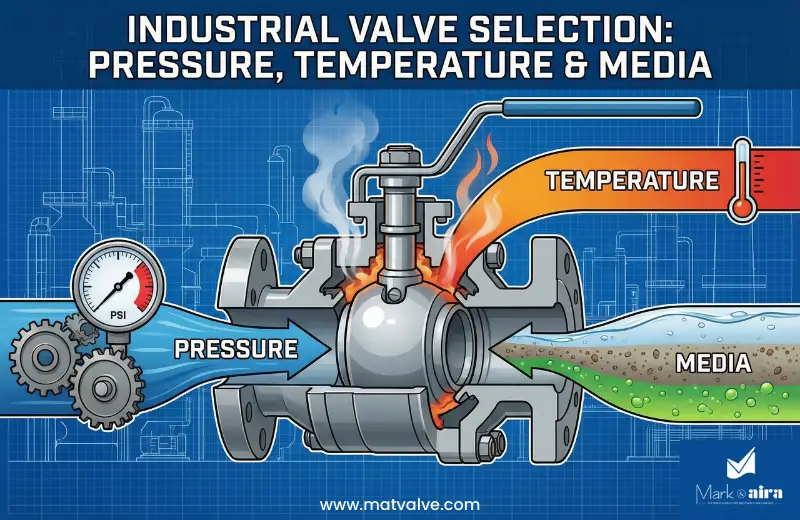
In the industrial world, valves aren’t one-size-fits-all. A valve that works perfectly for cold water at 50 PSI might fail instantly with hot steam at the same pressure. As a procurement manager or engineer, you have to look beyond the price tag. You need to look at the “Triad” of selection: Pressure, Temperature, and Media.
Get these three right, and your system runs for years. Get one wrong, and you buy that valve twice.
This guide breaks down exactly how to navigate these three critical factors. It’s the deep-dive companion to our broader Industrial Valve Selection Guide, so keep that open in another tab for reference on specific valve types.
Why Valve Selection Parameters Matter
Most buyers use the STAMPED method (Size, Temperature, Application, Media, Pressure, Ends, Delivery). That’s a good start. But STAMPED is just a list. It doesn’t tell you how these factors fight each other.
Pressure and Temperature are linked. You can’t separate them. As heat goes up, the pressure your valve can handle goes down.
And Media? That’s the wild card. The fluid inside the pipe determines if your expensive metal body turns into Swiss cheese in six months.
When you ignore the relationship between these three, you risk:
- Safety hazards: Blowouts injure people.
- Compliance issues: Failing API or ASME audits.
- Wasted budget: Replacing “cheap” valves every quarter costs more than buying the right one once.
Let’s break them down.
Selecting Valves by Pressure Rating
Pressure seems simple. You look at your pump. It says “100 PSI.” You buy a valve rated for 150 PSI. Done, right?
Not exactly.
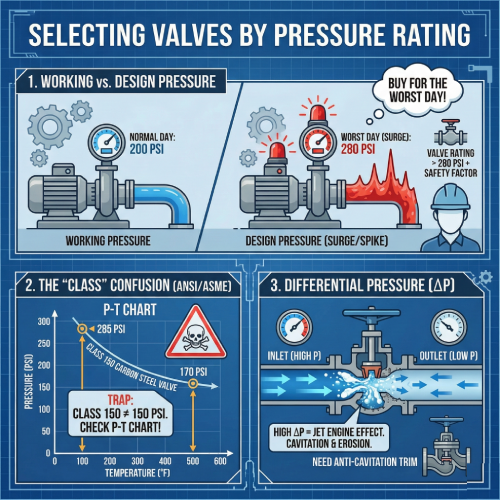
1. Working Pressure vs. Design Pressure
Never buy based on your “normal” day. You have to buy for your “worst” day.
Pumps surge. Systems spike during startup. Emergency shutdowns cause water hammer. If your normal working pressure is 200 PSI, but your surge pressure hits 280 PSI, a 250 PSI rated valve creates a risk.
Smart engineers apply a safety factor. They usually look for a valve that handles 10-20% more than the maximum possible system spike.
2. The “Class” Confusion (ANSI/ASME)
In the US and many international projects, we use “Classes” to rate valves (Class 150, 300, 600, etc.).
Here is the trap: Class 150 does not mean 150 PSI.
It’s a pressure-temperature rating category.
- At 100°F, a Class 150 carbon steel valve might handle 285 PSI.
- At 500°F, that same Class 150 valve might only handle 170 PSI.
If you don’t check the manufacturer’s P-T Chart (Pressure-Temperature Chart), you fly blind.
3. Differential Pressure (ΔP)
This is the pressure drop from the inlet to the outlet.
High differential pressure is nasty. It acts like a jet engine inside your valve. It speeds up the fluid. This causes cavitation—little bubbles that form and implode. These implosions eat away metal.
If you have high ΔP, a standard ball valve won’t cut it. You need a control valve with special “anti-cavitation” trim.
Selecting Valves by Temperature Range
Temperature changes everything. It changes how the metal behaves. It changes how the seals seal.
1. The Metal Gets Weaker
Physics creates a problem here. As metal gets hotter, it loses strength.
Imagine a steel pipe. It’s hard at room temperature. Heat it to 1000 degrees, and it gets softer. The same happens to your valve body.
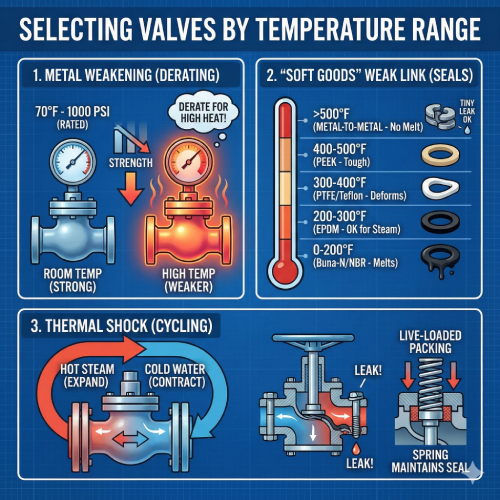
If your process runs hot, you can’t just look at the pressure rating on the nameplate. That rating assumes room temperature (usually around 70°F or 20°C). You have to derate the valve.
2. The “Soft Goods” are the Weak Link
The metal body usually survives the heat. The seats and seals usually don’t.
Most industrial valves (like ball or butterfly valves) use soft seats to stop the flow tight.
- Buna-N / NBR: Good for oil, but melts above 200°F.
- EPDM: Great for water/steam, handles up to 300°F, but oil kills it.
- PTFE (Teflon): The industry favorite. Handles chemicals well. But above 400°F? It deforms. It leaks.
- PEEK: Harder, tougher, takes heat up to 500°F.
If you go hotter than 500°F? You usually have to ditch soft seats entirely. You switch to Metal-to-Metal seated valves. They leak a tiny bit more (Class IV or V shutoff), but they don’t melt. Check our wide range of metal to metal ball valves.
3. Thermal Shock
Does your system cycle? Maybe it runs super hot steam for an hour, then flushes with cold water.
That rapid change expands and shrinks the metal. Bolts loosen. Gaskets crush. This causes external leaks. For cycling temps, you need “live-loaded” packing systems that use springs to keep the bolts tight even when the metal moves.
Selecting Valves by Media Type
What are you moving? This is usually the first question I ask a client. The “media” dictates the material.
We can group difficult media into three buckets.
1. Corrosive Fluids (Acids, Seawater, Caustics)
Corrosion is a silent killer. It eats the valve from the inside out. You won’t know until it sprays.
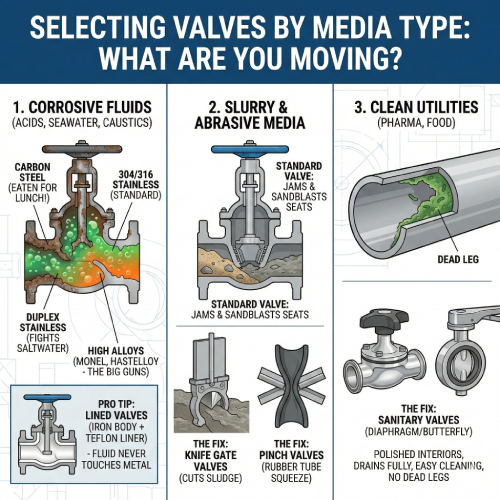
- Carbon Steel: Cheap and strong. But acids eat it for lunch.
- 304/316 Stainless Steel: The standard for mild chemicals and industrial environments.
- Duplex Stainless Steel: You need this for seawater. Salt attacks regular stainless steel (pitting corrosion). Duplex fights back.
- High Alloys (Monel, Hastelloy, Inconel): The big guns. Use these for sulfuric acid or chlorine. They cost a fortune, but they last.
Pro Tip:
“If high alloys break your budget, look at Lined Valves. These use a cheap iron body but line the inside with thick Teflon (PFA/PTFE). The fluid never touches the metal. You get high resistance for a lower price.”
2. Slurry & Abrasive Media
This is the hardest application. Slurry contains solids like sand, ash, rocks, and pulp.
Standard valves have pockets. A gate valve, for example, has a groove at the bottom for the gate to seat into. Slurry fills that groove. When you try to close the valve, the gate hits a wall of packed dirt. It jams.
Also, the moving particles act like sandpaper. They sandblast the valve seats every time you open or close it.
The Fix: Use Knife Edge Gate Valves. The gate has a sharp edge that cuts through the sludge. Or use Pinch Valves, which are basically rubber tubes you squeeze shut. No metal parts touch the flow.
3. Clean Utilities (Pharma, Food)
Here, the enemy isn’t corrosion. It’s bacteria.
You can’t have cracks or crevices where fluid sits and rots. We call these “dead legs.”
The Fix: You need Sanitary Valves (usually Diaphragm or Butterfly). They have polished interiors. They drain fully. They clamp apart easily for cleaning.
Industry-Specific Examples
Let’s see how this looks in the real world.
Oil & Gas Pipelines
- Pressure: Huge. Class 600 or higher.
- Temp: Moderate.
- Media: Crude oil (dirty).
- Choice: Trunnion Mounted Ball Valves. They handle the pressure, and you can inject grease to keep them sealing even if the oil is dirty.
Wastewater Treatment
- Pressure: Low.
- Temp: Ambient.
- Media: Dirty water with solids.
- Choice: Plug Valves or Knife Gates. They don’t clog.
Steam Power Plants
- Pressure: High.
- Temp: Very High.
- Media: Clean steam.
- Choice: Chrome-Moly Globe Valves. They throttle the steam accurately and stand up to the extreme heat.
Common Selection Errors
I see these mistakes on purchase orders every week. Avoid them.
- Oversizing the Valve: Bigger isn’t better. Especially for control valves. If you buy a valve that is too big, it barely has to open to get the flow you need. It sits there, cracking open 5%, rattling and vibrating. This wears it out fast. Size the valve for the flow, not the pipe size.
- Buying “Carbon Steel” for Everything: “It’s just water,” you say. But if that water is near the ocean, the salty air rusts the outside of the valve in a year. The stem seizes. The handle snaps off. Check your external environment too.
- Ignoring Maintenance access: You bought a welded-body valve because it was cheap. Great. Now the seat leaks. You can’t open the valve to fix it. You have to cut it out of the pipe. You just spent $2,000 to replace a $20 part. Think about Total Cost of Ownership.
Conclusion
Selecting an industrial valve isn’t just about reading a spec sheet. It’s about understanding the battle between your process and the hardware.
You have to balance the pressure surges against the temperature spikes. You have to match the material to the media.
If you respect the Pressure-Temperature-Media relationship, you build a system that is safe, efficient, and boring. And in this industry, “boring” is good. Boring makes money. Unexpected excitement costs money.
Need help sizing the right valve? Don’t guess. Let our technical team run the numbers for you.
- Contact Us Today for a customized quote or technical help.