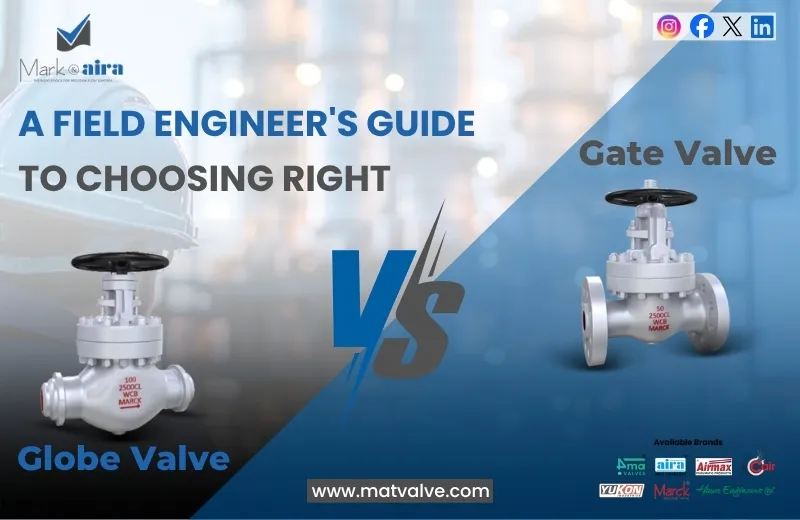
Gate valves are for full isolation — open or closed, never in between. Globe valves are for throttling and regulation. Use the wrong one and you risk vibration, seat damage, and costly downtime. This guide breaks down exactly when to reach for each.
What Is a Gate Valve?
A gate valve works like a sliding gate — a wedge or disc drops perpendicularly across the flow path to block it completely. When fully open, fluid passes through a straight, unobstructed bore, which means virtually no pressure drop.
The critical rule: gate valves are on/off devices. Partially opening a gate valve exposes the seating surfaces to high-velocity flow, causing vibration, erosion, and premature failure. They are not throttling valves.
Gate valves are physically taller than globe valves when open but have a shorter face-to-face length, which matters in tight pipework layouts.
What Is a Globe Valve?
A globe valve has a disc that moves up and down against a seat inside a globe-shaped body. This design forces fluid to change direction as it passes through — which creates higher resistance but gives precise control over flow rate.
Globe valves handle frequent operation well. The disc-to-seat contact is designed for repeated throttling without damage, making them the go-to choice wherever you need to regulate, not just stop.
Key Differences at a Glance
Feature | Gate Valve | Globe Valve |
Primary Function | Full isolation (on/off) | Flow regulation and throttling |
Pressure Drop | Very low (straight-through flow) | Higher (fluid changes direction) |
Throttling Capability | None — causes seat damage | Excellent |
Frequency of Operation | Infrequent (stays fully open/closed) | Frequent cycling is fine |
Body Shape | Taller, linear | Rounded, compact |
Sealing | Wedge or parallel gate | Disc against seat |
Typical Pressure Range | Up to Class 2500 | Up to Class 2500 |
Space Required | Taller (rising stem) | More face-to-face length |
Pressure Drop: Where It Matters
In long pipelines and large-diameter systems — such as crude oil transmission, cooling water mains, or desalination feed lines — minimising pressure drop is critical to energy efficiency. Gate valves win here. Their straight-through flow path adds virtually no resistance when fully open.
Globe valves, by contrast, can produce a pressure drop 3–5x higher than an equivalent gate valve. In a high-flow main line, this translates to real energy cost. Reserve globe valves for flow control duty, where that resistance is exactly what you need.
When to Use a Gate Valve
In long pipelines and large-diameter systems — such as crude oil transmission, cooling water mains, or desalination feed lines — minimising pressure drop is critical to energy efficiency. Gate valves win here. Their straight-through flow path adds virtually no resistance when fully open.
Globe valves, by contrast, can produce a pressure drop 3–5x higher than an equivalent gate valve. In a high-flow main line, this translates to real energy cost. Reserve globe valves for flow control duty, where that resistance is exactly what you need.
When to Use a Globe Valve
Choose a globe valve when:
- You need to regulate or throttle the flow. Steam control, cooling water bypass, chemical dosing — anywhere precise flow adjustment is required.
- The valve operates frequently. Globe valves are built for repeated open-close cycles. Their seating design handles it without the erosion risk that kills gate valves used as throttles.
- Tight shutoff under high pressure is critical. Globe valves form a tighter seal under pressure, which makes them preferred for high-pressure steam systems and boiler feedwater.
- Flow direction is one-way. Globe valves are directional — install them correctly with the flow under the disc.
Common globe valve applications in the UAE industry: steam systems in power plants, boiler feedwater control, process control in petrochemical plants, and pharmaceutical process lines.
Common Mistakes in UAE Industrial Plants
- Throttling with a gate valve. This is the most expensive mistake in the field. Partially open gate valves vibrate, erode the gate and seat, and eventually fail to seal — leading to unplanned shutdowns.
- Using a globe valve as a main-line isolator. The added pressure drop wastes pump energy continuously. Over a year of operation in a large plant, this adds up significantly in electricity costs.
- Ignoring ambient temperature. UAE plants often operate in 45°C+ ambient conditions.
Both valve types need stem packing and sealing material rated for elevated temperatures. Graphite packing and PTFE seats rated for ≥200°C are standard in local specifications.
Quick Selection Checklist
Use this to make the call quickly on site:
Questions | Gate Valve | Globe Valve |
Is this valve staying open 90% of the time? | ✓ | |
Do you need to control flow rate, not just stop it? | ✓ | |
Is low pressure drop essential? | ✓ | |
Will the valve cycle frequently? | ✓ | |
Is it on a main isolation line? | ✓ | |
Is it on a steam, boiler, or bypass line? | ✓ |
For UAE plants needing both gate and globe valve supply in a single order — with technical datasheets, IBR approvals, and fast Dubai-based delivery — contact the Mark & Aira Valves team for a quote. We stock both in carbon steel, stainless steel, and alloy grades across Class 150 to Class 2500.
Browse our full range: Gate Valves | Industrial Valve Selection Guide
Frequently Asked Questions
Can I use a gate valve for throttling?
No. You should never use a gate valve for throttling or flow regulation. Gate valves are designed strictly for full isolation (on/off). Using them in a partially open position causes high-velocity fluid to vibrate the gate, leading to “chattering,” seat erosion, and eventual sealing failure. For flow regulation, always choose a globe valve.
Why does a globe valve have a higher pressure drop than a gate valve?
A globe valve has a higher pressure drop because its internal design forces fluid to change direction multiple times (usually in an S-shape) to pass through the seat. This creates turbulence and resistance. In contrast, a gate valve provides a straight-through, unobstructed path when fully open, resulting in minimal friction loss.
What is the main difference between a gate valve and a globe valve?
The main difference is their function: a gate valve is used for isolation (stopping/starting flow) with minimal pressure loss, while a globe valve is used for regulation (controlling the flow rate). Physically, gate valves have a linear sliding gate, while globe valves use a disc that moves vertically against a stationary seat.
Which valve is better for high-pressure steam systems?
Globe valves are generally preferred for high-pressure steam and boiler feedwater systems. Their design allows for a tighter seal under high pressure and provides the precise control needed for steam bypass and chemical dosing. Gate valves are only used in steam systems for main-line isolation where they remain fully open.
Is a globe valve bi-directional?
Unlike gate valves, globe valves are typically uni-directional. They are designed with a specific flow direction (usually flow-under-the-disc) to assist in opening the valve and to protect the stem packing. Installing a globe valve backward can lead to operational difficulties and increased wear on the internal components.
How do maintenance requirements differ between gate and globe valves?
Globe valves are generally easier to maintain and repair in-line because the disc and seat can be accessed without removing the entire valve body from the pipeline. Gate valves are more difficult to repair once the seating surfaces are eroded, often requiring the full replacement of the valve in high-stakes industrial environments.